
English spelling can sometimes make simple words look more complicated than they really are. Uncollectible and Uncollectable are two examples that often leave writers wondering whether they are interchangeable or have separate meanings. Both contain the word collect, both describe something that cannot be collected, and both appear in discussions about money, debts, payments, and business records.
The interesting part is that neither spelling is automatically wrong. Both are accepted forms of English, although their usage varies by region. American English generally favors uncollectible, whereas uncollectable is commonly associated with British English.
These words are especially useful in financial writing, but they can also appear in other situations where something cannot be gathered or recovered. Knowing how to use them correctly can help you prepare clearer emails, reports, articles, and professional documents.
Uncollectible
Irrecoverable
Uncollectable
Irrecoverable
Uncollectible vs Uncollectable: Quick Answer
The main difference between these words is their spelling preference, not their meaning.
| Word | Common Regional Preference | Meaning |
| Uncollectible | American English | Something that cannot be collected or recovered |
| Uncollectable | British English | Something that cannot be collected or recovered |
Both spellings are correct. If you are writing for American readers, uncollectible is generally the preferred option. If your audience follows British English, uncollectable is a suitable choice.
Remember: The two forms express the same idea. You do not need to learn two separate definitions.
What Does Uncollectible Mean?
Uncollectible is an adjective that describes something that cannot be collected or is unlikely to be recovered. It is frequently used when talking about money that a person or organization owes but cannot pay.
For example, a company may provide services to a customer and send an invoice afterward. If the customer never pays and the company has little chance of receiving the money, the outstanding amount may be described as uncollectible.
The word is particularly common in accounting, banking, credit management, and business communication.
Examples of Uncollectible
- The bank classified the unpaid loan as uncollectible.
- The company reported several uncollectible customer accounts.
- The accountant reviewed the uncollectible balances.
- Some old debts become uncollectible after repeated collection attempts.
- The business introduced new rules to reduce uncollectible payments.
In each example, the word describes an amount that is not expected to be recovered.
What Does Uncollectable Mean?
Uncollectable is another accepted spelling of the same adjective. It describes something that cannot reasonably be collected, received, or recovered.
This form is commonly used in British English, although readers in other English-speaking regions may also recognize it.
For example, a business may have several customers who have failed to pay their outstanding invoices. After reviewing the situation, the business may decide that some of those amounts are uncollectable.
Examples of Uncollectable
- The company reviewed its uncollectable debts.
- The unpaid invoice was considered uncollectable.
- Several uncollectable accounts appeared in the financial report.
- The organization attempted to recover the uncollectable amount.
- The lender introduced stricter checks to prevent uncollectable loans.
The meaning remains the same as uncollectible. Only the spelling changes.
Why Are There Two Different Spellings?
English has several words that appear in alternative forms. Sometimes these variations develop through regional spelling traditions, while in other cases dictionaries recognize more than one accepted spelling.
The endings -ible and -able are used to form adjectives. They often express whether something can be done or is possible.
Consider these examples:
| Word | General Meaning |
| Readable | Capable of being read |
| Washable | Capable of being washed |
| Reversible | Capable of being reversed |
| Collectible | Capable of being collected |
| Collectable | Capable of being collected |
When the prefix un- is added, the meaning becomes negative.
- Collectible → Uncollectible
- Collectable → Uncollectable
Both versions communicate the idea that collection is not possible or is unlikely.
There is no need to invent a separate meaning for each spelling. Their difference is mainly based on accepted spelling preferences.
Related Comparison: Manuel vs Manual: Which Spelling Is Correct?
American English vs British English
Regional spelling is one of the easiest ways to decide which version to use.
Uncollectible in American English
American English generally favors uncollectible. You may see it in:
- Business reports
- Banking documents
- Accounting discussions
- Financial statements
- Educational articles
- General American writing
Example:
“The company recorded a loss because several customer accounts were uncollectible.”
Uncollectable in British English
British English commonly uses uncollectable. It can appear in financial documents, business communication, and general writing.
Example:
“The company recorded a loss because several customer accounts were uncollectable.”
Both sentences communicate exactly the same information.
Which Form Should International Writers Choose?
If your readers come from different countries, either spelling may be understood. The best approach is to select one spelling convention and maintain it throughout your document.
For example, if you use American English, write uncollectible consistently. If you follow British English, use uncollectable.
Changing between the two forms without a reason can make an article or report look poorly edited.
How to Use These Words in Sentences
Both words function as adjectives. They describe nouns and can appear in several positions within a sentence.
Before a Noun
An adjective can appear before the noun it modifies.
Examples:
- The company has several uncollectible accounts.
- The bank reviewed an uncollectible loan.
- The accountant prepared a report on uncollectable debts.
- The organization identified uncollectable payments.
After a Linking Verb
These adjectives can also appear after verbs such as is, are, was, were, and became.
Examples:
- The debt is uncollectible.
- The unpaid amount was uncollectable.
- Several customer balances became uncollectible.
- The payment appears uncollectable.
In Longer Descriptions
You can also use either spelling in a longer phrase.
Examples:
- The business estimated the total value of its uncollectible customer accounts.
- The lender reviewed the risk associated with uncollectable loans.
- The accountant prepared a detailed list of uncollectible balances.
The grammatical role does not change when you switch between the two spellings.
Uncollectible and Uncollectable in Business and Accounting
These words are particularly useful in business because companies often provide goods or services before receiving payment.
When a customer buys something on credit, the business may allow payment at a later date. The amount owed becomes part of the company’s accounts receivable.
However, not every customer pays their bills. Some payments are delayed, while others may never arrive.
If a business determines that an outstanding amount is unlikely to be recovered, it may describe that amount as uncollectible or uncollectable.
What Are Uncollectible Accounts?
Uncollectible accounts are amounts owed by customers that a business does not expect to receive.
For example, imagine a marketing agency that completes work worth $5,000 for a customer. The agency sends an invoice, but the customer does not pay.
After several reminders and attempts to resolve the matter, the agency determines that recovering the money is unlikely.
The outstanding balance may then be described as an uncollectible account.
Why Do Accounts Become Uncollectible?
There are several possible reasons:
- A customer may experience financial difficulties.
- A business may close before paying its invoices.
- A borrower may become unable to repay a loan.
- A payment dispute may remain unresolved.
- A customer may become unreachable.
- Collection attempts may fail over an extended period.
An overdue payment does not automatically become uncollectible. A company must consider the available information before reaching that conclusion.
Common Business Expressions
| Expression | Meaning |
| Uncollectible debt | Money that is unlikely to be recovered |
| Uncollectable account | An account that cannot reasonably be collected |
| Uncollectible payment | A payment that cannot be obtained |
| Uncollectable balance | An outstanding amount unlikely to be received |
| Uncollectible loan | A loan that is unlikely to be repaid |
The spelling depends on the preferred English variety, but the basic meaning stays the same.
Related Comparison: Atleast or At Least, Which Spelling Is Correct?
Uncollectible vs Uncollected: Are They the Same?
Although these words look similar, they describe different situations.
Uncollected means that something has not been collected yet. It may still be possible to collect it later.
Uncollectible means that something cannot reasonably be collected or recovered.
Compare these examples:
- The package remained uncollected at the post office.
- The customer’s debt was classified as uncollectible.
The first sentence means that nobody had collected the package. The second means that recovering the money was unlikely.
More Examples
| Uncollected | Uncollectible |
| The parcel is still uncollected. | The debt is uncollectible. |
| The documents remained uncollected. | The account was considered uncollectible. |
| The order is waiting to be collected. | The unpaid balance is unlikely to be recovered. |
This is an important distinction because something that has not been collected may still be perfectly collectible.
Uncollectible vs Unpaid
Unpaid simply means that a person has not paid an amount that is due.
Uncollectible describes an amount that cannot reasonably be recovered.
For example:
“The customer has an unpaid invoice.”
This sentence only tells us that payment has not been made.
“The invoice has been classified as uncollectible.”
This indicates that the business does not expect to receive the money.
An unpaid invoice may be settled tomorrow. An uncollectible invoice is considered unlikely to be paid.
Uncollectible vs Unrecoverable
The word unrecoverable refers to something that cannot be recovered, restored, or obtained again.
Uncollectible is more specifically connected with the inability to collect something, especially money or debts.
Examples:
- The lender considered the debt uncollectible.
- The company suffered an unrecoverable data loss.
- The payment was classified as uncollectible.
- The damaged information was unrecoverable.
Although these words can overlap in certain financial situations, they should not automatically replace one another.
Common Mistakes to Avoid
Writers sometimes misunderstand this spelling pair. Here are some errors worth avoiding.
Mistake: Calling Uncollectable Incorrect
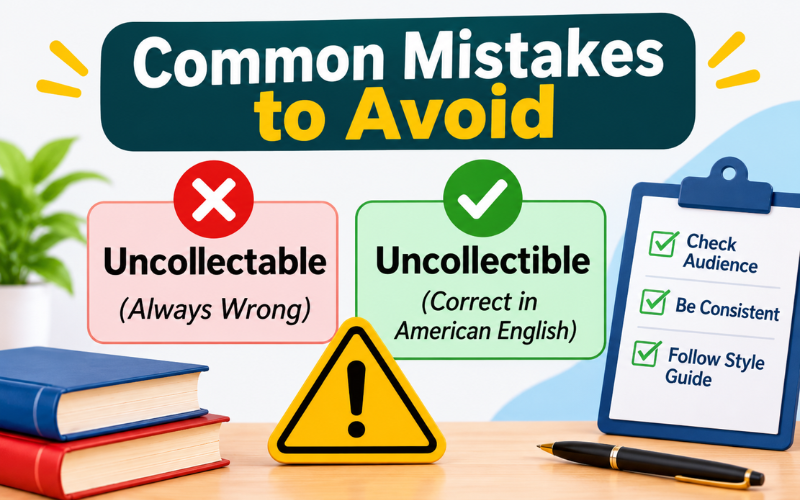
Some people assume that uncollectable is always a spelling mistake.
Correction: Both spellings are accepted. Their regional preferences differ.
Mistake: Giving Each Word a Different Definition
It is incorrect to claim that one means unpaid while the other means impossible to collect.
Correction: Both have the same basic meaning.
Mistake: Switching Between Spellings
Using uncollectible in one section and uncollectable in another can make a document inconsistent.
Correction: Choose a spelling style and follow it throughout your writing.
Mistake: Confusing Uncollected With Uncollectible
These words are related but are not interchangeable.
Correction: Use uncollected when something has not been collected yet and uncollectible when collection is unlikely or impossible.
Related Comparison: Offered vs Offerred: Which Spelling Is Correct?
Practical Tips for Choosing the Correct Spelling
You can make the right choice without memorizing complicated grammar rules.
Consider your readers. Use uncollectible for American English audiences and uncollectable when following British English conventions.
Check your organization’s style guide. Businesses, publishers, and educational institutions may have specific spelling preferences.
Stay consistent. Do not alternate between the two forms without a clear reason.
Use the word naturally. Both spellings are adjectives, so make sure the word describes the correct noun.
Check financial terminology. If you are writing an accounting or legal document, follow the terminology used by the relevant organization.
More Examples for Better Understanding
Here are additional sentences showing how both forms work in different situations.
| Uncollectible | Uncollectable |
| The company removed the uncollectible balance. | The company removed the uncollectable balance. |
| The lender reviewed its uncollectible loans. | The lender reviewed its uncollectable loans. |
| The accountant identified uncollectible accounts. | The accountant identified uncollectable accounts. |
| The business reported uncollectible payments. | The business reported uncollectable payments. |
| The debt became uncollectible. | The debt became uncollectable. |
Notice that every sentence has the same meaning in both columns.
FAQs
Is Uncollectible a Real Word?
Yes. Uncollectible is a recognized English adjective. It describes something that cannot be collected or is unlikely to be recovered.
Is Uncollectable Grammatically Correct?
Yes. Uncollectable is also an accepted spelling. It is commonly associated with British English and has the same meaning as uncollectible.
Which Word Is Correct in American English?
Uncollectible is generally preferred in American English. It is commonly used in financial and business writing.
Which Spelling Is Preferred in British English?
Uncollectable is commonly preferred in British English. However, writers should follow the spelling guide used by their publication or organization.
Do These Words Have Different Meanings?
No. Both describe something that cannot reasonably be collected or recovered. The difference is primarily regional spelling preference.
Can I Use Uncollectible for Money?
Yes. It is especially common when describing debts, loans, payments, and customer accounts that are unlikely to be recovered.
Does Uncollected Mean the Same as Uncollectible?
No. Uncollected means something has not been collected yet. Uncollectible means that collecting it is not realistically possible or is unlikely.
Should I Use Both Spellings in One Article?
It is better to choose one form and use it consistently. This makes your writing more professional and easier to follow.
Test Your Knowledge
Choose the correct answer for each question.
1. Which spelling is generally preferred in American English?
a) Uncollectable
b) Uncollectible
2. Which spelling is commonly associated with British English?
a) Uncollectible
b) Uncollectable
3. What do both words mean?
a) Already collected
b) Impossible or unlikely to be collected
c) Ready for collection
4. Which word means that something has not been collected yet?
a) Uncollected
b) Uncollectible
c) Uncollectable
5. Complete the sentence using the American English spelling:
“The bank classified the unpaid loan as __________.”
a) Uncollectable
b) Uncollectible
6. Are both spellings accepted?
a) Yes
b) No
Answers and Explanations
- b) Uncollectible — This is the usual American English preference.
- b) Uncollectable — This form is commonly associated with British English.
- b) Impossible or unlikely to be collected — Both spellings express the same idea.
- a) Uncollected — It means something has not been collected yet.
- b) Uncollectible — The question asks for the American English form.
- a) Yes — Both spellings are accepted English variants.
Conclusion
The choice between Uncollectible vs Uncollectable is mainly about regional spelling preferences. Both words are correct, both have the same meaning, and both can describe debts, payments, accounts, and other things that cannot reasonably be collected.
If you follow American English, uncollectible is generally the better choice. If you follow British English, uncollectable is commonly preferred.
The most important thing is to understand the meaning and remain consistent. Once you know the regional preference, choosing the right spelling becomes a simple part of your writing process.
For More Comparisons Visit: Wordzify
Pingback: Grately vs Greatly: Which Spelling Is Correct? - wordzify.com