

The spelling “Offered vs Offerred” can be confusing because English has many verbs that double a final letter when they take the -ed ending. This makes offerred look possible, especially when writing quickly. However, only one of these forms is correct in standard English.
The correct word is offered, which is the past tense and past participle of offer. It can be used when someone gives something, provides help, suggests an option, or makes an opportunity available.
In this guide, we’ll break down the difference between offered and offerred with simple examples, sentence patterns, common spelling mistakes, and useful comparisons.
Quick Answer
Offered is the correct spelling.
- ✅ Offered — correct
- ❌ Offerred — incorrect
Example:
The company offered me a new position.
The word offered is the past tense and past participle of offer.
The simple rule
Offer + ed = Offered
Not:
Offer + red = Offerred
The final r in offer is not doubled when -ed is added.
| Form | Correct? | Example |
| Offer | ✅ | They offer free delivery. |
| Offers | ✅ | The store offers discounts. |
| Offering | ✅ | The company is offering help. |
| Offered | ✅ | They offered me a discount. |
| Offerred | ❌ | Incorrect spelling |
What Does “Offered” Mean?
Offered is the past form of offer. It can have several meanings depending on the sentence.
It may mean that someone:
- gave something to another person
- made something available
- suggested something
- proposed an opportunity
- agreed to provide something
- presented help or assistance
For example:
She offered me a cup of tea.
Here, she presented or gave the tea to me.
Another example:
The company offered him a job.
Here, the company proposed a job opportunity.
And:
He offered to help us.
In this sentence, he volunteered or expressed his willingness to help.
So, although offered is one word, it can be used in several useful ways.
Why Is “Offerred” Wrong?
The mistake usually comes from the spelling pattern people expect when a verb ends in a consonant.
For example:
- stop → stopped
- plan → planned
- admit → admitted
Because some verbs double their final consonant before -ed, it can be tempting to write:
offer → offerred ❌
But offer does not follow that pattern.
The correct form is:
offer → offered ✅
The word already ends in r, but the spelling does not require another r before -ed.
Offered vs Offerred: The Main Difference
There is no difference in meaning between the two forms because offerred is not a standard English spelling.
The actual comparison is between the accepted spelling and a common spelling error.
| Point | Offered | Offerred |
| Standard spelling | ✅ Yes | ❌ No |
| Dictionary form | ✅ Yes | ❌ No |
| Past tense of “offer” | ✅ Yes | ❌ No |
| Past participle | ✅ Yes | ❌ No |
| Used in formal writing | ✅ Yes | ❌ No |
| Extra “r” needed | No | Incorrectly added |
Examples
❌ The school offerred me a scholarship.
✅ The school offered me a scholarship.
❌ They offerred several solutions.
✅ They offered several solutions.
❌ He offerred to drive us home.
✅ He offered to drive us home.
The correction is simply to remove the extra r.
Why Do People Spell “Offered” as “Offerred”?
There are a few natural reasons this error appears.
The Verb Looks Like It Should Double the “R”
When people think about verbs that double their final consonant, they may apply the rule too broadly.
For example:
stop → stopped
prefer → preferred
This can make offer → offerred seem reasonable at first glance.
But spelling rules depend on the individual word and its ending, pronunciation, and stress pattern.
The Extra “R” Looks Familiar
Words such as:
- preferred
- referred
- occurred
contain doubled letters.
Because these words are common, writers sometimes transfer the same spelling pattern to offered.
But:
preferred ✅
does not mean:
offerred ❌
Fast Typing Can Cause the Error
When people type quickly, they may write the word based on how they expect it to look rather than checking its established spelling.
That is especially common when writing:
- emails
- messages
- school assignments
- social media posts
- quick notes
Offered vs Offerred in a Sentence
The easiest way to recognize the correct form is to see offered in different sentence patterns.
Offering Something to Someone
She offered me some advice.
My friend offered me a ride.
The waiter offered us another table.
Making Something Available
The website offered several payment options.
The hotel offered free breakfast.
The university offered online courses.
Making a Suggestion
He offered a different explanation.
She offered a practical solution.
The manager offered an alternative plan.
Volunteering to Do Something
One especially common structure is:
offered to + verb
Examples:
He offered to help with the project.
She offered to drive us home.
They offered to pay for dinner.
I offered to explain the problem.
Notice that the verb after offered to stays in its base form.
Offered + Object vs Offered to Do Something
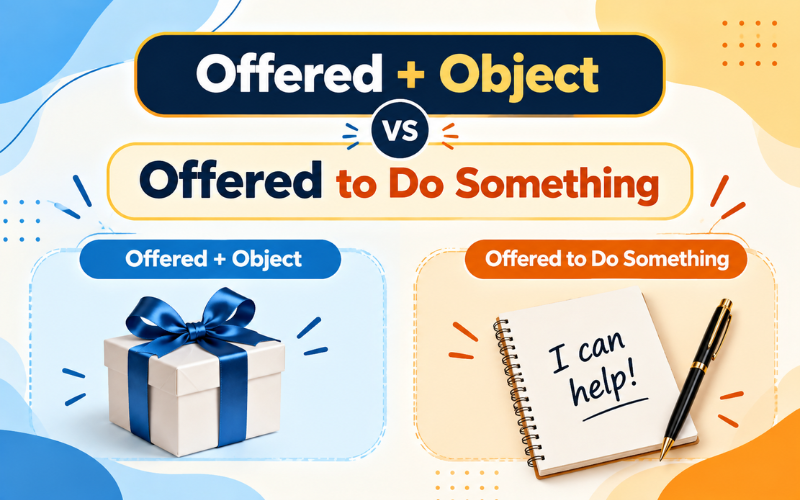
These two sentence patterns are worth learning because they are both very common.
Offered + Object
The company offered him a job.
Structure:
Subject + offered + person + thing
Another example:
My uncle offered me some useful advice.
Offered to + Verb
The company offered to hire him.
Structure:
Subject + offered + to + base verb
Another example:
My uncle offered to help me.
Compare the Two
| Pattern | Example |
| offered + person + thing | She offered me some tea. |
| offered + to + verb | She offered to make some tea. |
Both are correct, but they express the idea in slightly different ways.
Offered vs Offer: What Is the Difference?
Offer is the base form, while offered is its past tense and past participle.
| Form | Use | Example |
| Offer | Present/base form | They offer free shipping. |
| Offers | Present with he/she/it | The store offers discounts. |
| Offered | Past tense | The store offered a discount. |
| Offering | -ing form | The store is offering a discount. |
Present
The company offers flexible working hours.
Past
The company offered flexible working hours last year.
Continuous
The company is offering flexible working hours.
This makes it easier to see where offered belongs.
Offered vs Offering
These two forms are also easy to confuse.
Offered
Offered usually refers to something that happened in the past.
The company offered me a position last week.
Offering
Offering can describe an action happening now or can function as a noun.
The company is offering me a position.
As a noun:
The company’s latest product offering attracted attention.
The spelling and grammar change depending on the role of the word.
Offered vs Preferred: Why Is One “rr” and the Other Not?
This is an interesting spelling comparison.
| Word | Correct form |
| offer | offered |
| prefer | preferred |
| refer | referred |
| occur | occurred |
Why don’t they all behave the same way?
English spelling depends partly on the pronunciation and structure of the base word. In words such as prefer and refer, the stress and ending create a different spelling pattern when -ed is added.
With offer, the correct form is simply:
offer → offered
So it is better to learn the established spelling of each common verb rather than assuming that every verb ending in r follows the same pattern.
Related Comparison: Atleast or At Least, Which Spelling Is Correct?
Offered vs Offered: Is There a Pronunciation Difference?
No.
There is no standard English pronunciation difference between offered and the misspelled form offerred.
The problem is spelling, not pronunciation.
Offered is commonly pronounced with two syllables:
OF-ferd
The spelling does not require an additional r.
This is one reason the mistake can survive unnoticed: when you say the word aloud, you do not hear a separate extra “r.”
When to Use “Offered”
You can use offered in many everyday and professional situations.
Jobs and Employment
The company offered her a full-time position.
He was offered a job after the interview.
Help
Sarah offered to help me with my homework.
Money
They offered me $500 for the old laptop.
Food and Drinks
The host offered us some coffee.
Services
The hotel offered free transportation to the airport.
Advice
She offered some useful advice.
Opportunities
The university offered him a scholarship.
The meaning changes slightly with context, but the spelling remains offered.
A Small Grammar Point: “Offered” in Passive Sentences

Offered is also commonly used in passive constructions.
For example:
She was offered a new position.
He was offered a scholarship.
We were offered a refund.
Here, the person receiving the offer becomes the subject of the sentence.
Compare:
Active:
The company offered Sarah a job.
Passive:
Sarah was offered a job.
The word offered remains unchanged.
Common Mistakes With “Offered”
Mistake 1: Adding an Extra “R”
❌ The company offerred me a position.
✅ The company offered me a position.
This is the main spelling mistake associated with the word.
Mistake 2: Confusing “Offered” With “Offer”
❌ Yesterday, the company offer me a job.
✅ Yesterday, the company offered me a job.
Because the action happened in the past, the past-tense form is required.
Mistake 3: Using “Offered” After “Did”
After did, use the base form offer, not offered.
❌ Did she offered you a job?
✅ Did she offer you a job?
The auxiliary did already marks the past tense.
Mistake 4: Using “Offered” After “Will”
After will, use the base verb.
❌ They will offered us a discount.
✅ They will offer us a discount.
Mistake 5: Writing “Offerred to Help”
❌ He offerred to help me.
✅ He offered to help me.
The correct structure is:
offered to + base verb
A Simple Spelling Test
When you are unsure whether to write offered or offerred, remove the -ed ending mentally.
You get:
offer
Now add -ed:
offer + ed = offered
There is no need to add another r.
This quick check can prevent the mistake while writing.
Offered in Different Types of Writing
The word offered is useful in almost every kind of English writing.
In Academic Writing
The study offered several possible explanations.
In Business Writing
The supplier offered a lower price.
In News Writing
The organization offered assistance to affected families.
In Personal Writing
My brother offered to pick me up.
In Everyday Conversation
She offered me some cake.
You do not need a different spelling for formal or informal English.
A Useful Word Family
Learning related forms together can make spelling easier.
| Word | Example |
| Offer | They offer several services. |
| Offers | The company offers discounts. |
| Offered | They offered us a discount. |
| Offering | The company is offering a new service. |
| Offerable | Rare and uncommon in everyday English |
The four forms you are most likely to need are offer, offers, offered, and offering.
Quick Comparison: Similar Past-Tense Spellings
Some words ending in consonants double the final letter when -ed is added, while others do not.
| Base Word | Past Form |
| stop | stopped |
| plan | planned |
| prefer | preferred |
| refer | referred |
| offer | offered |
| open | opened |
| visit | visited |
This is why simply applying one spelling rule to every verb can lead to mistakes.
Can “Offerred” Ever Be Correct?
In standard modern English, offerred is not the correct spelling of the past tense of offer.
If you mean that someone gave, proposed, provided, or made something available, use:
offered
For example:
The company offered free delivery.
Not:
The company offerred free delivery.
Practice Session: Offered or Offerred?
Try these questions before checking the answers.
Part 1: Choose the Correct Spelling
1. The company ______ me a better position.
A. offerred
B. offered
C. offerd
2. She ______ to help with the presentation.
A. offered
B. offerred
C. offer
3. The hotel ______ free breakfast to its guests.
A. offerred
B. offered
C. offerd
4. He was ______ a scholarship.
A. offerred
B. offered
C. offering
5. They ______ us a reasonable price.
A. offered
B. offerred
C. offer
Part 2: Correct the Sentences
Rewrite each sentence correctly.
6. The manager offerred me a promotion.
7. She offerred to drive us home.
8. The store offerred a 20% discount.
9. Did the company offered you a contract?
10. They will offered free delivery next month.
Answers and Explanations
1. B — Offered
The company offered me a better position.
Why? The correct past tense of offer is offered.
2. A — Offered
She offered to help with the presentation.
Why? The correct structure is offered to + base verb.
3. B — Offered
The hotel offered free breakfast to its guests.
Why? The action happened in the past.
4. B — Offered
He was offered a scholarship.
Why? This is a passive construction using the past participle offered.
5. A — Offered
They offered us a reasonable price.
Why? The past form contains only one r after the “e.”
6. Corrected
The manager offered me a promotion.
Explanation: Remove the extra r from offerred.
7. Corrected
She offered to drive us home.
Explanation: Use offered to + base verb.
8. Corrected
The store offered a 20% discount.
Explanation: The correct past form is offered.
9. Corrected
Did the company offer you a contract?
Explanation: After did, use the base form offer, not offered.
10. Corrected
They will offer free delivery next month.
Explanation: After will, use the base form offer.
Final Rule to Remember
If you remember only one thing from this article, remember this:
Offer → Offered
There is no second “r” added before -ed.
So:
- ❌ offerred
- ✅ offered
Once you remember the base verb offer, the correct spelling becomes much easier to recognize.
FAQs
Is it offered or offerred?
Offered is correct. Offerred is a misspelling.
Does offered have one R or two Rs?
The correct spelling is offered. The word contains the single r that is already present in offer; another r is not added before -ed.
What is the past tense of offer?
The past tense of offer is offered.
Present: They offer free delivery.
Past: They offered free delivery.
Is “offerred” ever correct?
No, not when you are using it as the standard past tense or past participle of offer. Use offered instead.
Why is preferred spelled with two Rs but offered with one?
English spelling patterns differ from word to word. Prefer → preferred, while offer → offered. The spelling of one verb should not automatically be applied to another.
Conclusion
The choice between Offered vs Offerred is straightforward: offered is the correct standard spelling, while offerred is an incorrect form. The word offered is the past tense and past participle of offer, and it can describe giving something, making something available, suggesting an option, providing help, or presenting an opportunity.
The most useful spelling rule is simple:
Offer + ed = Offered
Remember that an extra r is not added. Also keep an eye on grammar around the word: after did and will, use offer, while structures such as offered to help correctly use the past form.
With these patterns in mind, you can avoid one of the more common spelling mistakes involving offer and use offered naturally in emails, essays, articles, conversations, and professional writing.
For More Comparisons Visit: Wordzify