
English has many words that look almost the same but serve different purposes. Tweek vs Tweak is one such spelling confusion. Both forms look similar, and their pronunciation is often alike, so it is easy to see why people mix them up while writing.
When you want to describe a small change made to improve something, the correct word is tweak. You can tweak a sentence, change a few settings, adjust a recipe, or make a small improvement to a design. The word is useful in everyday conversations as well as in school, business, and technology.
The spelling tweek is not the standard form of this word. However, it may appear as a person’s name, a fictional character’s name, a username, or a brand name. In such cases, the spelling depends on the name itself.
Tweek
Usually a misspelling.
Tweak
Small adjustment.
What Does Tweak Mean?
Tweak means to make a small change to something, often to improve it or make it work better. The change is usually limited, so the original thing remains mostly the same.
For example, if a sentence sounds unclear, you might change a few words instead of rewriting the entire paragraph. That small edit is a tweak.
The word can be used for many things, including writing, designs, plans, schedules, recipes, machines, and computer settings.
Examples of tweak
- I need to tweak the introduction before submitting my assignment.
- She tweaked the recipe by adding more herbs.
- The designer tweaked the colors on the website.
- We tweaked the meeting time to suit everyone.
- He tweaked the settings on his computer.
- The editor made a small tweak to the headline.
- I tweaked my presentation after receiving feedback.
- The technician tweaked the machine settings.
Each example describes a small adjustment rather than a complete replacement.
Does tweak always mean making something better?
Not always. People usually make tweaks because they want to improve something, but the result is not guaranteed to be better.
For example:
- I tweaked the settings, and the computer worked faster.
- I tweaked the recipe, but the taste was still too sweet.
- We tweaked the schedule, although another change was needed later.
The word describes the adjustment, not whether it succeeds.
Can tweak be a noun?
Yes. Tweak can be used as both a verb and a noun.
As a verb: “I will tweak the paragraph.”
As a noun: “The paragraph needs one small tweak.”
In the first sentence, the word describes an action. In the second, it refers to the adjustment itself.
What Does Tweek Mean?
Tweek is not the standard spelling of the English word meaning “to make a small adjustment.” When you want to express that meaning, use tweak.
However, Tweek may be used as a name, username, business name, or fictional character name. If it is an official name, its spelling should be kept as it is.
For example:
- Tweek is the name displayed on the gaming profile.
- The fictional character is called Tweek.
- The artist uses Tweek as a nickname.
- The business name is written as Tweek Studio.
These examples use the spelling as a name, not as the ordinary verb meaning to make a small change.
Why do people write tweek?
There are several possible reasons:
- Similar pronunciation: The two forms sound alike to many speakers.
- Typing errors: Someone may type the wrong vowel while writing quickly.
- Spelling confusion: A writer may not remember whether the word uses ea or ee.
- Unfamiliar vocabulary: Someone who has not seen the word in writing may guess its spelling.
- Names and usernames: Seeing Tweek used as a name may cause a reader to confuse it with the standard word.
Although these reasons explain the confusion, they do not make tweek the standard spelling for a small adjustment.
Tweek vs Tweak
The most important difference is their role in standard English. Tweak has a clear meaning and several common grammatical forms. Tweek does not normally replace it in ordinary writing.
| Feature | Tweek | Tweak |
| Standard word for a small adjustment | No | Yes |
| Used as an ordinary verb meaning “adjust slightly” | No | Yes |
| Can be used as a name | Yes | Yes, if chosen as a name |
| Past-tense form for the intended meaning | Not standard | Tweaked |
| Form ending in -ing | Not standard for this meaning | Tweaking |
| Plural noun for small adjustments | Not standard | Tweaks |
| Suitable for everyday writing about adjustments | No | Yes |
Examples showing the difference
When describing an edit
Incorrect: I need to tweek this sentence.
Correct: I need to tweak this sentence.
When describing several changes
Incorrect: We made a few tweeks to the page.
Correct: We made a few tweaks to the page.
When referring to a name
Correct: Tweek is the username shown on the profile.
Here, the spelling may be correct because it is a name.
How can you choose the right word?
Ask yourself what you are trying to express.
- If you mean a small adjustment, use tweak.
- If you are referring to a person, character, username, or brand called Tweek, preserve that spelling.
- If you are unsure whether a spelling is part of a name, check the original source.
Why Is Tweak the Correct Spelling?
The standard word is spelled t-w-e-a-k. Its common forms keep the same basic spelling:
- Tweak
- Tweaks
- Tweaked
- Tweaking
The ending changes to suit the sentence, but the main word does not change to tweek.
A simple spelling trick
Think of tweak as T + WEAK. This memory trick can help you remember that the word contains ea, not ee.
For example:
- I want to tweak the headline.
- I want to tweak the color.
- I want to tweak the instructions.
This is simply a way to remember the spelling. The actual meaning of tweak is to make a small adjustment.
Words with similar spelling patterns
English has several words containing the letters ea, including:
- Speak
- Break
- Sneak
- Leak
- Tweak
Their pronunciations are not always predictable from the letters alone. Learning the full spelling of tweak is more reliable than guessing from sound.
How to Use Tweak in a Sentence
Tweak is usually a verb when it describes the action of making a small change. The sentence structure depends on what you want to say.
1. Tweak something
Use this pattern when naming the thing being adjusted.
Structure: Subject + tweak + object.
Examples:
- I tweak my notes before class.
- She tweaked the design.
- We need to tweak the schedule.
- The editor tweaked the wording.
- He tweaked the settings on his phone.
2. Tweak something to achieve a result
Use this pattern when you want to explain the reason for the adjustment.
Examples:
- I tweaked the title to make it shorter.
- She tweaked the recipe to reduce the sweetness.
- The developer tweaked the layout to improve readability.
- We tweaked the timetable to give everyone more time.
- The teacher tweaked the activity to make it easier.
The words beginning with to explain the purpose of the change.
3. Tweak something slightly
Words such as slightly, a little, and a bit can emphasize that the change is small.
Examples:
- Please tweak the wording slightly.
- I tweaked the settings a little.
- She tweaked the design a bit.
- We need to tweak the schedule slightly.
These extra words are optional because tweak already suggests a small adjustment.
4. Tweak something again
Sometimes one adjustment is not enough. You can use tweak again when another small change is needed.
Examples:
- I will tweak the introduction again.
- The team tweaked the layout once more.
- We tested the settings and tweaked them again.
This expression is common when someone is making repeated improvements.
Tweak as a Verb and a Noun
The same word can perform two different grammatical jobs.
| Form | Grammatical role | Example |
| Tweak | Verb | I will tweak the title. |
| Tweak | Noun | The title needs a tweak. |
| Tweaks | Verb | She tweaks the wording. |
| Tweaks | Noun | The page needs two tweaks. |
| Tweaked | Past-tense verb | He tweaked the design. |
| Tweaking | Verb form | They are tweaking the settings. |
When tweak is a verb
The word describes an action.
- I tweaked the paragraph.
- She tweaks the colors before publishing.
- They are tweaking the website.
When tweak is a noun
The word refers to the small change itself.
- The paragraph needs a tweak.
- I made one tweak to the image.
- The team suggested three tweaks to the proposal.
A useful sentence pattern is make a tweak to something.
For example: “I made a tweak to the final paragraph.”
You can also use the verb directly: “I tweaked the final paragraph.”
Both sentences are correct.
Tweak vs Adjust
Tweak and adjust have similar meanings, but they are not always interchangeable.
Tweak usually suggests a small change. Adjust is a broader word that can describe a minor or more substantial change.
| Feature | Tweak | Adjust |
| Main meaning | Make a small change | Change something to make it suitable |
| Size of change | Usually small | Small or large |
| Tone | Often conversational | Neutral and widely used |
| Example | Tweak the headline | Adjust the schedule |
Examples
- I tweaked the wording to make it clearer.
- I adjusted the document to meet the required length.
- She tweaked the brightness on her screen.
- She adjusted the chair to make it more comfortable.
Both words are correct in many situations. Choose tweak when you want to highlight a small modification. Choose adjust when you want a general term for changing something to suit a need.
Related Comparison: Offered vs Offerred: Which Spelling Is Correct?
Tweak vs Change
The word change has a wider meaning than tweak. A change may be small or large, while a tweak generally refers to a minor adjustment.
For example:
- We changed the entire website design.
- We tweaked the spacing between the headings.
The first sentence suggests a substantial change. The second describes a limited adjustment.
| Situation | Better choice |
| Making a small edit to a sentence | Tweak |
| Replacing an entire article | Change or rewrite |
| Moving a button slightly | Tweak |
| Changing careers | Change |
| Adjusting the seasoning in a recipe | Tweak |
| Replacing a complete business plan | Change or revise |
Choosing the right word helps readers understand how much work was done. If a project was completely redesigned, calling it a tweak may make the work sound much smaller than it was.
Tweak vs Revise
Revise means to review and change something, often to improve its quality, accuracy, or suitability. The changes may be small or extensive.
Tweak usually describes a smaller adjustment.
Examples:
- I tweaked one sentence in the report.
- I revised the report after receiving detailed feedback.
The first sentence describes a limited edit. The second suggests a broader review, although the actual changes could still be small.
| Feature | Tweak | Revise |
| Main focus | Small adjustment | Review and change |
| Scope | Usually limited | Small or extensive |
| Common use | Wording, settings, designs | Reports, essays, policies |
| Example | Tweak the introduction | Revise the entire document |
Use tweak when you are making a small improvement. Use revise when you are reviewing and changing a larger section or the overall content.
Tweak vs Fine-Tune
Fine-tune means to make careful adjustments to improve performance, accuracy, or results. It is close in meaning to tweak, but it can place more emphasis on careful optimization.
Examples:
- We tweaked the settings.
- We fine-tuned the settings for better performance.
Both sentences describe adjustments. The second suggests a more deliberate process of getting the settings right.
| Feature | Tweak | Fine-tune |
| Meaning | Make a small adjustment | Make careful adjustments for better results |
| Common tone | Conversational | Often technical or professional |
| Typical use | Wording, plans, layouts | Performance, systems, processes |
| Example | Tweak the design | Fine-tune the design |
The difference depends on the context. A person can use either word when making small adjustments to a design, but fine-tune may be more suitable when careful optimization is the main purpose.
Tweak vs Modify
Modify means to change something, often without replacing it completely. It is common in formal, technical, and professional writing.
Tweak is more conversational and generally suggests a smaller change.
Examples:
- We tweaked the plan after the meeting.
- We modified the plan to meet the new requirements.
The first sounds like a minor adjustment. The second may describe a more substantial change.
| Context | Tweak | Modify |
| Business | Tweak the proposal | Modify the proposal |
| Technology | Tweak the settings | Modify the configuration |
| Education | Tweak an activity | Modify an activity |
| Everyday conversation | Very common | Also correct |
Neither word is always better. Choose the one that accurately describes the change and suits the tone of the sentence.
Tweak vs Fix
Tweak means to make a small adjustment. Fix usually means to repair something or solve a problem.
For example:
- I tweaked the headline to make it more interesting.
- I fixed the broken link in the article.
The headline was not necessarily wrong; it simply needed improvement. The broken link, however, needed to be repaired.
| Situation | Suitable word |
| Making a small improvement | Tweak |
| Repairing something broken | Fix |
| Changing a setting slightly | Tweak |
| Correcting a technical fault | Fix |
| Improving a sentence without changing its meaning | Tweak |
A tweak may help fix a problem, but the words do not mean exactly the same thing.
Tweak vs Touch Up
Touch up often means to make small improvements to the appearance or finish of something. It is frequently used for photographs, artwork, paint, and written material.
Tweak can be used for a wider range of adjustments, including settings, schedules, plans, and wording.
Examples:
- I tweaked the image dimensions.
- I touched up the photograph to remove a small mark.
- She tweaked the introduction.
- She touched up the final paragraph before publishing.
| Feature | Tweak | Touch up |
| Main use | Small adjustments of many kinds | Minor improvements to appearance or finish |
| Writing | Yes | Yes |
| Photography | Yes | Yes |
| Settings and schedules | Common | Less common |
| Example | Tweak the layout | Touch up the image |
If you are changing a setting, tweak may be more natural. If you are correcting a small visual imperfection, touch up may be more specific.
Using Tweak in Everyday Conversation

Tweak is common in everyday speech because it gives a short, natural way to describe a small adjustment.
At home
- Can you tweak the television settings?
- I tweaked the recipe a little.
- Let’s tweak the furniture arrangement.
- I need to tweak the temperature.
At school
- I tweaked my assignment before submitting it.
- The teacher asked me to tweak the conclusion.
- We tweaked our presentation after practicing.
- I made a few tweaks to my notes.
At work
- Could you tweak the email before I send it?
- We need to tweak the schedule.
- I made a few tweaks to the proposal.
- Let’s tweak the wording so it sounds clearer.
In casual messages
- I’ll tweak it and send it back.
- Just a couple of tweaks left.
- I tweaked the design a bit.
- The plan needs one final tweak.
These expressions work well when the change is small and the audience does not need a detailed explanation.
Tweak in Technology
Technology is one area where tweak is frequently used. Devices, applications, websites, and software often need small changes after their initial setup.
Website design
A designer might tweak:
- Font size
- Line spacing
- Button placement
- Image dimensions
- Page margins
- Heading styles
- Color contrast
- Mobile layout
Example: “The designer tweaked the mobile layout so the buttons were easier to use.”
The sentence describes a limited adjustment rather than a complete redesign.
Software settings
A user might tweak brightness, notification preferences, sound levels, or display settings.
Examples:
- I tweaked the display settings.
- She tweaked the notification preferences.
- The technician tweaked the device configuration.
- We tweaked the application settings after testing.
Programming
Developers may use tweak when making a small change to code or configuration.
Example: “The developer tweaked the spacing rules to improve the page layout.”
For a technical report, a more specific sentence may be clearer: “The developer changed the spacing values in the stylesheet.”
A tweak does not always improve performance. It may help, have no noticeable effect, or cause another problem. Testing helps determine whether the change should be kept.
Related Comparison: Atleast or At Least, Which Spelling Is Correct?
Tweak in Writing and Editing
Writers often make small changes before publishing a document. These changes may involve the title, introduction, headings, sentence structure, or word choice.
Tweaking a title
Original: “Some Useful Tips That Can Help You Write Better Articles”
Tweaked: “Tips for Writing Better Articles”
The second title is shorter and more direct.
Tweaking an introduction
Original: “This guide will explain the difference between the two words and provide examples that can help readers use them correctly.”
Tweaked: “Learn the difference between the two words through clear examples.”
The second version uses fewer words while keeping the main idea.
Tweaking headings
Original: “More Information”
Tweaked: “Common Spelling Mistakes”
The revised heading tells readers what the section covers.
Tweaking an email
Original: “I am writing this message because I wanted to ask whether you might be able to review the document.”
Tweaked: “Could you please review the document?”
The second sentence is shorter and more direct. The best choice depends on the relationship between the sender and the reader.
Small edits can improve clarity, but not every problem can be solved with a tweak. A document with major factual errors or a confusing structure may need a more extensive revision.
Tweak in Business and Marketing
Businesses often make small changes to products, services, messages, and work processes. The word tweak can describe these adjustments without suggesting that the entire plan has been replaced.
Marketing messages
A team may tweak a message to make its main benefit clearer.
Example: “The team tweaked the campaign message to make the main benefit easier to understand.”
Product development
A company may tweak a product after receiving customer feedback.
Example: “The company tweaked the packaging after customers reported difficulty opening it.”
Customer service
A business might tweak its instructions to reduce confusion.
Example: “We tweaked the instructions customers receive after placing an order.”
Team planning
Examples include:
- We tweaked the project timeline.
- The manager tweaked the meeting agenda.
- The team made a few tweaks to the workflow.
For major organizational changes, words such as restructure, redesign, or revise may describe the work more accurately.
Tweak in Cooking and Recipes
A recipe can be tweaked when a cook changes an ingredient, cooking time, temperature, or seasoning to suit a particular taste.
Examples:
- I tweaked the recipe by adding more garlic.
- She tweaked the sauce to make it less spicy.
- We tweaked the baking time after using a different pan.
- He tweaked the seasoning before serving the meal.
- The chef made a small tweak to the dressing.
A tweak usually leaves the recipe largely unchanged. Adding a little lemon juice to a dressing may be a tweak, while replacing most of the ingredients and changing the cooking method may be a much larger revision.
The word describes the adjustment, not whether everyone will prefer the result.
Tweak in Art and Design
Artists, photographers, designers, and writers often make small changes near the end of a project.
Common adjustments include:
- Increasing spacing between elements
- Changing the size of a heading
- Moving an image slightly
- Adjusting a background color
- Aligning text
- Improving contrast
- Changing a line of dialogue
Examples:
- The artist tweaked the background color.
- I tweaked the crop to improve the composition.
- The writer tweaked the dialogue.
- She made a small tweak to the illustration.
- The photographer tweaked the contrast before exporting the image.
A project may need more than small adjustments, however. If the design is confusing or the story structure does not work, a broader revision may be necessary.
Common Mistakes With Tweek and Tweak
Here are frequent spelling and usage mistakes, along with their corrections.
| Incorrect form or usage | Correct form | Reason |
| Tweek the title | Tweak the title | Standard spelling |
| Several tweeks | Several tweaks | Correct plural noun |
| She tweeked it | She tweaked it | Correct past tense |
| He is tweeking it | He is tweaking it | Correct -ing form |
| I made a tweak the paragraph | I made a tweak to the paragraph | Correct noun pattern |
| Calling a complete redesign a tweak | Redesign or revise, if the change is substantial | More accurate word choice |
Mistake 1: Writing tweek instead of tweak
Incorrect: I need to tweek the title.
Correct: I need to tweak the title.
The standard spelling uses ea.
Mistake 2: Writing tweeks instead of tweaks
Incorrect: We made several tweeks to the layout.
Correct: We made several tweaks to the layout.
Mistake 3: Writing tweeked instead of tweaked
Incorrect: She tweeked the introduction.
Correct: She tweaked the introduction.
Mistake 4: Writing tweeking instead of tweaking
Incorrect: He is tweeking the settings.
Correct: He is tweaking the settings.
Mistake 5: Using tweak for a major change
If a company has completely redesigned its website, saying that it only tweaked the website may understate the work. Choose redesigned when that is what actually happened.
Mistake 6: Assuming tweak always means repair
A tweak can improve something that is already working. For example, you might tweak the colors of a design simply because you prefer a different look.
Mistake 7: Correcting a name unnecessarily
If a fictional character or username is officially spelled Tweek, preserve that spelling when referring to the name.
Mistake 8: Confusing noun and verb patterns
Correct verb: “I tweaked the paragraph.”
Correct noun: “I made a tweak to the paragraph.”
Both sentences are grammatical, but their structures differ.
Tweak in British and American English
For the meaning “to make a small adjustment,” tweak is the standard spelling in both British and American English. There is no general spelling rule that changes it to tweek in either variety.
| English variety or context | Correct form |
| American English | Tweak |
| British English | Tweak |
| Canadian English | Tweak |
| Australian English | Tweak |
| Formal international English | Tweak |
| A name intentionally spelled Tweek | Keep the name’s spelling |
For example, both American and British writers can say:
“I tweaked the settings before saving the file.”
The spelling remains the same.
How to Remember the Correct Spelling
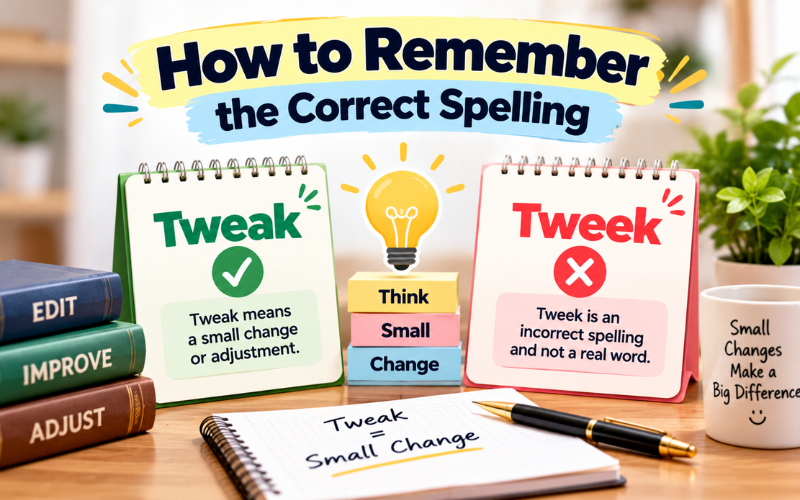
If you often confuse tweek and tweak, these simple habits can help.
1. Remember the letters. The standard spelling is T-W-E-A-K.
2. Use the memory trick. Think of tweak as “T + weak.” This may help you remember the ea combination.
3. Learn the word family. Practice tweak, tweaks, tweaked, and tweaking together.
4. Remember one example. “I need to tweak this sentence” is a simple sentence to keep in mind.
5. Check the meaning. If you mean a small adjustment, choose tweak.
6. Preserve names. If Tweek is an actual name, check the original spelling rather than changing it automatically.
7. Proofread related forms. Look for tweeked, tweeking, and tweeks when they are used to describe adjustments.
Reading aloud can help you find awkward wording, but it may not reveal this particular spelling error because the two forms can sound alike. A spelling check is useful as well.
Correct Forms of Tweak
| Intended meaning | Correct form | Example |
| Make a small change | Tweak | I will tweak the title. |
| Makes a small change | Tweaks | She tweaks the wording. |
| Made a small change | Tweaked | We tweaked the schedule. |
| Making a small change | Tweaking | He is tweaking the layout. |
| One small adjustment | A tweak | The page needs a tweak. |
| More than one adjustment | Tweaks | The page needs two tweaks. |
| Small changes to a process | Minor tweaks | We made minor tweaks to the process. |
When Tweek is a confirmed name, keep its original spelling. These standard forms apply when you are using tweak to describe an adjustment.
Practice: Choose the Correct Word
Choose the correct answer for each sentence before checking the explanation.
Question 1
I need to ______ the title before publishing the page.
A. Tweek
B. Tweak
Answer: B. Tweak
The sentence describes making a small change to a title.
Question 2
We made three small ______ to the website.
A. Tweeks
B. Tweaks
Answer: B. Tweaks
The plural form is tweaks.
Question 3
She ______ the recipe yesterday.
A. Tweaked
B. Tweeked
Answer: A. Tweaked
The past tense is tweaked.
Question 4
The developer is ______ the settings.
A. Tweeking
B. Tweaking
Answer: B. Tweaking
The correct form ending in -ing is tweaking.
Question 5
Which sentence is correct?
A. I made a tweak to the paragraph.
B. I made a tweek to the paragraph.
Answer: A. I made a tweak to the paragraph.
Tweak is the correct spelling for a small adjustment.
Question 6
The character’s official name is Tweek. Should the spelling automatically be changed to Tweak?
A. Yes
B. No
Answer: B. No
A name should retain its intended spelling.
Question 7
Which sentence uses tweak as a noun?
A. I tweaked the settings.
B. The settings need one tweak.
Answer: B. The settings need one tweak.
Here, tweak names the adjustment.
Question 8
Which word usually suggests a small adjustment?
A. Tweak
B. Redesign
Answer: A. Tweak
A redesign usually suggests a more substantial change.
Question 9
He usually ______ the wording before sending an email.
A. Tweaks
B. Tweak
Answer: A. Tweaks
The subject he takes the present-tense form tweaks.
Question 10
Which sentence is correct?
A. They tweaked the plan last week.
B. They tweeked the plan last week.
Answer: A. They tweaked the plan last week.
The correct past-tense form is tweaked.
Practice: Correct the Spelling
Rewrite each sentence using the correct form.
- I want to tweek the headline.
- The editor made two tweeks to the introduction.
- She tweeked the settings before saving the file.
- He is tweeking the layout.
- The report needs a few tweeks.
- I made a tweek to the final paragraph.
- We tweeked the schedule after the meeting.
- The designer is tweeking the image dimensions.
- She usually tweekes her notes before class.
- The application received several small tweeks.
Correct answers
- I want to tweak the headline.
- The editor made two tweaks to the introduction.
- She tweaked the settings before saving the file.
- He is tweaking the layout.
- The report needs a few tweaks.
- I made a tweak to the final paragraph.
- We tweaked the schedule after the meeting.
- The designer is tweaking the image dimensions.
- She usually tweaks her notes before class.
- The application received several small tweaks.
The main pattern stays the same: tweak is the base form, tweaked is the past form, tweaking is the -ing form, and tweaks can be a plural noun or a present-tense verb.
FAQs
1. Is Tweek or Tweak correct?
Tweak is correct when you mean to make a small adjustment. Tweek is not the standard spelling for that meaning, although it may appear as a name.
2. What does tweak mean in simple words?
Tweak means to make a small change to something, often to improve it or make it more suitable.
3. Is tweek a real word?
It is not the standard spelling of the ordinary verb meaning “make a small adjustment.” It may be used as a name, username, brand, or nonstandard spelling.
4. What is the past tense of tweak?
The past tense is tweaked.
Example: “I tweaked the article yesterday.”
5. Is tweeking correct?
Not when you mean making a small adjustment. The correct form is tweaking.
Conclusion
The difference between Tweek vs Tweak is mainly a matter of spelling and context. When you want to describe a small change to a sentence, design, recipe, plan, or setting, tweak is the correct word. Its common forms are tweaks, tweaked, and tweaking.
The spelling tweek may be used for a name or another deliberately chosen label, but it should not replace tweak in ordinary English writing when you mean to make a small adjustment.
For More Comparisons Visit: Wordzify
Pingback: Dysregulated vs Disregulated: Meaning, Usage and All Info - wordzify.com