
Choosing between Ally vs Allie can be confusing because both spellings sound alike when spoken. You may come across these words while writing a personal message, choosing a name, reading a story, or describing someone who provides support. Although they look and sound similar, their uses are not exactly the same.
The main difference is that ally is an established English word that describes a supporter, partner, or someone who cooperates with another person or group. It can also be used as a personal name. Allie, on the other hand, is primarily used as a first name or nickname. Both spellings are acceptable when they represent someone’s actual name, but only ally is the standard spelling of the common English word meaning a supporter.
Knowing when to use each form can help you avoid confusion, especially when writing sentences where the meaning depends on the spelling. Whether you are learning English, preparing an article, or deciding between these two names, understanding their differences will make your writing more accurate.
Ally
Trusted Friend
Allie
Noble Name
What Does Ally Mean?
The word ally refers to a person, organization, country, or group that supports or cooperates with another. Such a relationship may develop because the people or groups share similar interests, goals, responsibilities, or beliefs.
An ally is someone who stands alongside another person and provides assistance when needed. This support may involve friendship, teamwork, professional cooperation, or a shared purpose.
For example, imagine two classmates preparing for an important examination. One student helps the other understand difficult lessons, shares useful notes, and offers encouragement. In this situation, the helpful student can be described as an ally.
The word is not limited to personal relationships. It is also widely used in business, politics, international relations, education, and social discussions.
Examples:
- My best friend has always been a loyal ally.
- The two countries became allies after signing an agreement.
- She found an ally who supported her business plans.
- Every successful team needs a dependable ally.
- The organization gained an important ally in the community.
- He decided to ally himself with the local group.
In these sentences, ally communicates support, cooperation, or partnership.
Ally as a Noun
As a noun, ally identifies someone who provides support or works together with another person or group.
It can refer to a friend, colleague, business partner, organization, or even a country.
Examples:
- My brother is my strongest ally.
- She became an important ally during the project.
- The company needs a reliable ally to expand its services.
- Our country maintains friendly relationships with several allies.
- A good friend can become your greatest ally.
- The team welcomed a new ally before the competition.
- Every student deserves an ally who encourages their progress.
- The organization found an ally in a respected community leader.
The word can be used in both formal and informal communication. Its meaning remains connected to support and cooperation.
Ally as a Verb
Ally can also function as a verb. In this form, it means to join, connect, or cooperate with another person or group.
The verb is useful when describing a decision to establish a partnership or work toward a shared objective.
Examples:
- The two companies decided to ally with each other.
- Several organizations allied to support the campaign.
- The country chose to ally itself with neighboring nations.
- Local businesses can ally to strengthen their communities.
- The groups allied against a common challenge.
- The smaller organization decided to ally with a larger institution.
The verb changes its form depending on the sentence:
| Verb Form | Example |
| Ally | They ally with local businesses. |
| Allies | She allies herself with the organization. |
| Allied | The two groups allied last year. |
| Allying | The companies are allying to improve their services. |
These forms all come from the same English verb.
What Is the Plural of Ally?
The plural form of ally is allies.
When talking about more than one supporter or partner, the final y changes to ies.
Examples:
- Both teams have become strong allies.
- The country maintains good relationships with its allies.
- Successful businesses often develop partnerships with reliable allies.
- The two organizations are now close allies.
- Good allies respect each other’s decisions.
This spelling rule is also found in other English words, including family/families and company/companies.
Remember that Allie is a personal name, while allies is the plural form of the common noun ally. They should not be confused simply because their spellings look similar.
What Does Allie Mean?
Allie is primarily a personal name used as a given name or nickname. It is often associated with longer names such as Allison, Alison, Alexandra, and Alexandria, although it can also be chosen independently.
Many people like this spelling because it has a friendly appearance and a familiar pronunciation. It is commonly used in everyday conversations, family settings, social introductions, and personal communication.
Unlike ally, the spelling Allie does not normally function as the standard English noun meaning a supporter.
Consider these sentences:
- Allie is joining us for dinner tonight.
- I spoke with Allie after the meeting.
- Allie enjoys reading historical novels.
- My cousin Allie lives in another city.
- Everyone congratulated Allie on her achievement.
- Allie recently started a new job.
In these examples, Allie identifies a particular person.
Allie as a Given Name
Some people have Allie as their official first name rather than using it as a shortened form of another name.
It can appear on birth certificates, school records, professional documents, invitations, and other official paperwork.
Examples:
- Allie started her university classes this week.
- Allie received an award for her excellent work.
- The teacher asked Allie to lead the presentation.
- Allie is learning how to play the piano.
- Everyone enjoyed Allie’s performance at the event.
When Allie is someone’s actual name, its spelling should be maintained in written communication.
Allie as a Nickname
Allie is also used as a shorter and more familiar form of several longer names.
Depending on personal preferences, it may be associated with:
- Allison
- Alison
- Alexandra
- Alexandria
- Alice
However, these connections are not strict naming rules. Someone named Allison may prefer Allie, Ally, Ali, or their complete name. Another person with the same full name may choose an entirely different nickname.
For example:
- Allison prefers to be called Allie.
- Alexandra uses Ally as her nickname.
- Alice prefers her full name.
The choice depends on the individual rather than a grammatical requirement.
Why Do People Choose the Name Allie?
There are several reasons why someone might select Allie as a first name or nickname.
1. Simple spelling: Allie is relatively short and easy to recognize.
2. Familiar pronunciation: Most English speakers pronounce it in a straightforward way.
3. Nickname flexibility: It can be associated with several longer names.
4. Personal preference: Some people simply like the appearance of Allie more than other variations.
5. Family connections: Parents may choose it because it is already familiar within their family.
These reasons explain why Allie continues to be used as a personal name.
Ally vs Allie: What Is the Main Difference?
The most important distinction between Ally and Allie is their role in written English.
Ally has an established dictionary meaning and can function as both a noun and a verb. Allie is mainly a proper name.
Although the two forms sound identical, their spelling helps readers understand what the writer intends to communicate.
| Comparison | Ally | Allie |
| Main use | Common English word and personal name | Personal name |
| Meaning | Supporter, partner, or collaborator | A person’s name |
| Grammar | Noun or verb | Proper noun when used as a name |
| Capitalization | Usually lowercase as a common noun | Capitalized as a name |
| Pronunciation | AL-ee | AL-ee |
| Verb form | Yes | No |
| Plural common-word form | Allies | Not applicable |
| Example | She is a loyal ally. | Allie is a loyal friend. |
1. Difference in Meaning
The two spellings communicate different things when used in ordinary sentences.
Ally describes a supportive relationship, while Allie identifies someone by name.
Compare:
Example 1: My sister is my closest ally.
This means the speaker’s sister provides support and encouragement.
Example 2: My sister’s name is Allie.
This tells the reader what the sister is called.
The difference becomes clear once you look at the purpose of each sentence.
2. Difference in Grammar
The word ally can be used as a noun or a verb.
As a noun:
- An ally offered to help.
- The ally supported our decision.
- Their ally attended the conference.
As a verb:
- They ally with local organizations.
- The two groups allied last year.
Allie, when used as a name, functions as a proper noun.
Examples:
- Allie called yesterday.
- We invited Allie to the event.
- Allie’s presentation was excellent.
Understanding these grammatical roles makes it easier to select the correct spelling.
Related Comparison: Atleast or At Least, Which Spelling Is Correct?
3. Difference in Capitalization
Capitalization is another useful way to distinguish the two forms.
When ally is used as an ordinary noun, it generally begins with a lowercase letter.
Examples:
- She became my closest ally.
- Every athlete needs a dependable ally.
- The country has several international allies.
When Ally or Allie is someone’s name, the first letter should be capitalized.
Examples:
- Ally is my neighbor.
- Allie is studying English.
- I met Ally at the library.
The same capitalization rule applies to other personal names.
4. Difference in Usage
The spelling depends on the context in which you are writing.
Use ally when describing:
- A supportive friend.
- A trusted partner.
- A person who helps someone.
- A country cooperating with another country.
- An organization working toward a shared goal.
Use Allie when referring to:
- Someone with Allie as their first name.
- A friend who uses Allie as a nickname.
- A fictional character named Allie.
- A person whose official records contain this spelling.
Both forms are useful, but they serve different purposes.
5. Difference in Written Communication
In messages, emails, school assignments, and professional documents, the surrounding sentence determines which form is suitable.
For example:
- She has been a wonderful ally throughout my career.
- Allie has been wonderful throughout my career.
The first sentence describes a supportive person. The second refers to someone named Allie.
The meaning changes even though the pronunciation remains the same.
Is Ally a Correct Name?
Yes. Ally is a recognized personal name and nickname.
Although ally is also an English word meaning a supporter, it can be used independently as someone’s given name.
Many people choose Ally because they prefer its short appearance, simple spelling, and familiar pronunciation.
It may also be used as a nickname for longer names such as:
- Allison
- Alison
- Alexandra
- Alexandria
However, Ally does not have to be a shortened version of another name. It can be a person’s complete first name.
Examples:
- Ally is starting university this year.
- I invited Ally to my birthday celebration.
- Ally works for an international company.
- Everyone knows Ally for her creative ideas.
- Ally received a special award.
In these sentences, Ally is a proper name rather than a common noun.
Is Ally a Good Choice for a Baby Name?
Ally can be a suitable option for parents who prefer short and recognizable names.
Its spelling is simple, and its pronunciation is familiar to many English speakers. It can also be used as a standalone name or as a nickname for a longer one.
Parents may select Ally because they like its appearance or because it has personal meaning within their family.
There is no grammatical rule that makes Ally incorrect as a given name.
Is Allie a Correct Name?
Yes. Allie is also a correct personal name.
It is commonly used as a first name and as a nickname for longer names. Some people use it throughout their lives, while others use it mainly among friends and family.
Examples:
- Allie is my childhood friend.
- Allie recently moved to a new apartment.
- I received a birthday card from Allie.
- Allie wants to become a writer.
- We celebrated Allie’s graduation.
The spelling is perfectly appropriate when it matches the person’s chosen name.
Is Allie Different From Allison?
Allie and Allison are not the same written name, but Allie can be used as a nickname for Allison.
For example:
- Allison is her full name.
- Allie is the name her friends use.
The same principle applies to other longer names that may have Allie as a nickname.
Not everyone with the name Allison will prefer Allie. It is always better to use the form that the individual chooses.
How to Use Ally Correctly in Sentences
The word ally appears in several different situations. Learning its common sentence patterns will help you understand its meaning and use it naturally.
Ally in Everyday Conversations
In ordinary conversations, people use ally to describe someone who provides support or stands beside another person.
Examples:
- My best friend is always my ally.
- Everyone needs an ally during difficult times.
- She became my strongest ally when I needed help.
- I am lucky to have such a dependable ally.
- A good ally listens without judging.
- My brother has always been an important ally.
The word can describe emotional support as well as practical assistance.
Ally in Education
Students and teachers may use the word when discussing cooperation, encouragement, and academic support.
Examples:
- A helpful classmate can become a valuable ally.
- The teacher became an ally for students who needed extra guidance.
- Every learner benefits from having an academic ally.
- The two schools became allies for an educational project.
- Parents can be important allies in a child’s learning journey.
Here, ally communicates a helpful connection between people or institutions.
Ally in Business
Business communication often uses ally to describe a company, professional, or organization that cooperates with another.
Examples:
- The startup found a valuable ally in a larger company.
- Our business needs a reliable ally.
- The two organizations became strategic allies.
- A trusted ally can help a company enter a new market.
- The manager developed strong relationships with business allies.
The term is useful when discussing professional partnerships and shared objectives.
Ally in Politics and International Relations
In political and international discussions, an ally is generally a country, government, or group that cooperates with another.
Examples:
- The two nations have remained close allies.
- The country consulted its allies before making a decision.
- International allies supported the agreement.
- Several governments became allies during the negotiations.
- The organization works with its international allies.
In these examples, ally refers to cooperation between larger groups rather than an ordinary friendship.
Ally in Friendship and Relationships
The word can also describe someone who supports another person emotionally.
Examples:
- A true friend can be your greatest ally.
- She became my ally when nobody understood my situation.
- I want to be an ally to people who need support.
- Good friends remain allies through difficult moments.
- His family has always been his strongest ally.
This use highlights loyalty, understanding, and encouragement.
How to Use Allie Correctly in Sentences
When Allie is a person’s name, it follows the normal rules for proper nouns.
It can appear at the beginning, middle, or end of a sentence, depending on the sentence structure.
Allie at the Beginning of a Sentence
Examples:
- Allie is preparing for her examination.
- Allie loves spending time with her family.
- Allie received a new opportunity at work.
- Allie enjoys traveling during the holidays.
- Allie is learning a new language.
Since Allie is a name, it begins with a capital letter.
Allie in the Middle of a Sentence
Examples:
- I invited Allie to the birthday party.
- My teacher asked Allie to explain the answer.
- We met Allie during the school event.
- Her brother helped Allie complete the project.
- Everyone appreciated Allie’s thoughtful suggestion.
The name remains capitalized even when it appears in the middle of a sentence.
Allie at the End of a Sentence
Examples:
- The invitation was sent to Allie.
- I received the message from Allie.
- The teacher selected Allie.
- We are waiting for Allie.
- This book belongs to Allie.
These examples demonstrate how the name works naturally in different sentence positions.
Using Allie’s in a Sentence
When showing possession, add an apostrophe and an s to the name.
Examples:
- Allie’s phone is on the table.
- I liked Allie’s presentation.
- Allie’s family is visiting this weekend.
- We attended Allie’s birthday celebration.
- The teacher praised Allie’s work.
The apostrophe indicates that something belongs to or is associated with Allie.
Related Comparison: Offered vs Offerred: Which Spelling Is Correct?
Ally vs Allie: Examples in Different Situations
Sometimes the easiest way to understand a spelling difference is to see both forms in realistic situations.
The following examples demonstrate how the meaning changes according to the context.
| Ally Example | Allie Example |
| She is my closest ally. | Allie is my closest friend. |
| We need a reliable ally. | We need to invite Allie. |
| The company found an ally. | Allie works for the company. |
| He became an important ally. | He introduced me to Allie. |
| The countries are allies. | Allie is visiting the countries. |
| My greatest ally supported me. | My greatest supporter is named Allie. |
| Every team needs an ally. | Every team invited Allie. |
Example: A Conversation Between Friends
Consider this short conversation:
Sarah: I am having trouble finishing my assignment.
Emma: You should ask your classmate for help. She could be a good ally.
Sarah: You mean Allie?
Emma: If her name is Allie, yes. She could also be your ally if she supports you.
This conversation demonstrates how the same pronunciation can represent either a personal name or a vocabulary word.
Example: A Workplace Situation
Imagine a company preparing to launch a new product.
- The manager needs an ally who can help with marketing.
- Allie is responsible for preparing the promotional material.
- The manager considers Allie a valuable ally.
- Allie agrees to work with the marketing team.
In this example, both forms appear naturally, but they have different purposes.
Allie identifies the employee, while ally describes her supportive role.
Ally vs Allie: Common Mistakes to Avoid
Although both spellings are acceptable in certain situations, writers sometimes use them incorrectly because they focus only on pronunciation.
Understanding the following mistakes can help prevent confusion.
Mistake 1: Using Allie Instead of Ally
Incorrect: She has always been my greatest Allie.
Correct: She has always been my greatest ally.
Explanation: The sentence describes someone who provides support. Therefore, the standard noun ally is required.
Mistake 2: Writing Ally Instead of Someone’s Name
Suppose someone’s name is Allie.
Incorrect: I invited Ally to the graduation ceremony.
Correct: I invited Allie to the graduation ceremony.
Explanation: If the person’s chosen spelling is Allie, it should not be changed simply because Ally sounds the same.
Mistake 3: Assuming Allie Is an Incorrect Word
Incorrect assumption: Allie is always a spelling mistake.
Correct understanding: Allie is a valid personal name.
Explanation: The spelling is appropriate when used as someone’s name or nickname. It simply does not replace the common noun ally.
Mistake 4: Assuming Ally Cannot Be a Name
Incorrect assumption: Ally can only mean a supporter.
Correct understanding: Ally can also be a personal name.
Explanation: Many English words are also used as personal names. Their meaning depends on the context.
Mistake 5: Forgetting Capitalization
Incorrect: My friend allie is coming tomorrow.
Correct: My friend Allie is coming tomorrow.
Explanation: A person’s name should begin with a capital letter.
Mistake 6: Confusing Allies With Allie
Incorrect: The country has several Allie.
Correct: The country has several allies.
Explanation: Allies is the plural form of the noun ally. Allie is a personal name.
Mistake 7: Changing Someone’s Preferred Name
Incorrect approach: Writing Ally when the person consistently uses Allie.
Correct approach: Using the person’s preferred spelling.
Explanation: Personal names do not have to follow the spelling of similar-sounding dictionary words.
Ally vs Allie: Is There a Difference in Pronunciation?
In common English pronunciation, Ally and Allie are generally pronounced the same way: AL-ee.
Both usually contain two syllables:
- AL: The first syllable.
- EE: The second syllable.
The difference is mainly visible in writing rather than speech.
For example, someone might introduce themselves by saying, “Hi, I’m Allie.” A listener cannot automatically determine whether the person’s name is written as Allie, Ally, or another variation.
This is why spelling names correctly is important.
Why Do Both Spellings Sound the Same?
English spelling does not always represent pronunciation in a one-to-one way. Different combinations of letters can produce the same or very similar sounds.
The endings in Ally and Allie both commonly represent the long E sound.
Other familiar examples of similar-sounding names and words can also be found in English.
When you are uncertain about a person’s name, asking for the spelling is the most reliable solution.
Ally vs Allie: Which Spelling Is Better for a Baby Name?
Parents may compare Ally and Allie when choosing a name for a child. Both are possible choices, and neither is automatically incorrect.
The decision usually depends on personal preference, family traditions, the desired appearance, and whether the name will be used independently or as a nickname.
| Consideration | Ally | Allie |
| Appearance | Short and simple | Friendly and familiar |
| Pronunciation | Usually AL-ee | Usually AL-ee |
| Can stand alone? | Yes | Yes |
| Can be a nickname? | Yes | Yes |
| English vocabulary meaning | Supporter or partner | No equivalent common-word meaning |
| Personal preference | Valid choice | Valid choice |
Choosing Ally
Parents might prefer Ally because:
- It has a short spelling.
- It is easy to recognize.
- It can stand independently.
- It is also an established English word.
- It may be a suitable nickname for a longer name.
Choosing Allie
Parents might prefer Allie because:
- It has a familiar nickname appearance.
- It is recognizable as a personal name.
- It can be used independently.
- It may be associated with longer names.
- It has a simple pronunciation.
There is no universal winner. The best spelling is the one that matches the family’s preference and intended use.
Ally vs Allie in Formal and Informal Writing
Both forms can appear in different types of writing, but their purpose must be clear.
In Academic Writing
When discussing support, cooperation, or partnerships, use ally.
Example:
“The organization developed relationships with several allies to support its educational program.”
When writing about a student or researcher named Allie, use the person’s name.
Example:
“Allie submitted her research paper before the deadline.”
In Professional Emails
The correct spelling depends on whether you are using the word as a noun or writing someone’s name.
Examples:
- We appreciate having your organization as an ally.
- Dear Allie, thank you for attending the meeting.
- Our company is looking for a reliable business ally.
In Social Media Posts
People may use either Ally or Allie as a username, display name, or personal reference.
Examples:
- So grateful to have an amazing ally by my side.
- Happy birthday, Allie!
- Everyone deserves an ally who believes in them.
When writing about a real person, check their preferred spelling rather than choosing one based on pronunciation.
In Stories and Creative Writing
Authors can use either Ally or Allie for fictional characters.
For example:
- Ally was always ready to help her friends.
- Allie walked into the classroom with a smile.
Both can be character names. The important thing is to maintain the selected spelling consistently throughout the story.
Related Words and Expressions With Ally
Learning related vocabulary can help you understand how ally works in English.
Allied
Allied is the past tense and past participle of the verb ally. It can also function as an adjective describing groups or people connected through cooperation.
Examples:
- The two organizations allied to achieve their goals.
- The allied countries signed a new agreement.
- The groups remained allied throughout the campaign.
Alliance
An alliance is a partnership or formal relationship between people, organizations, or countries.
Examples:
- The companies formed an alliance.
- Their alliance helped them complete the project.
- The two nations maintained a strong alliance.
Allies
Allies is the plural noun form of ally.
Examples:
- The organization works with several allies.
- Our allies supported the proposal.
- The teams became close allies.
Allying
Allying is the present participle of the verb ally.
Examples:
- The businesses are allying to expand their services.
- Several groups are allying around a common goal.
These related forms help explain the wider vocabulary family associated with ally.
Related Comparison: Manuel vs Manual: Which Spelling Is Correct?
How to Remember the Difference Between Ally and Allie
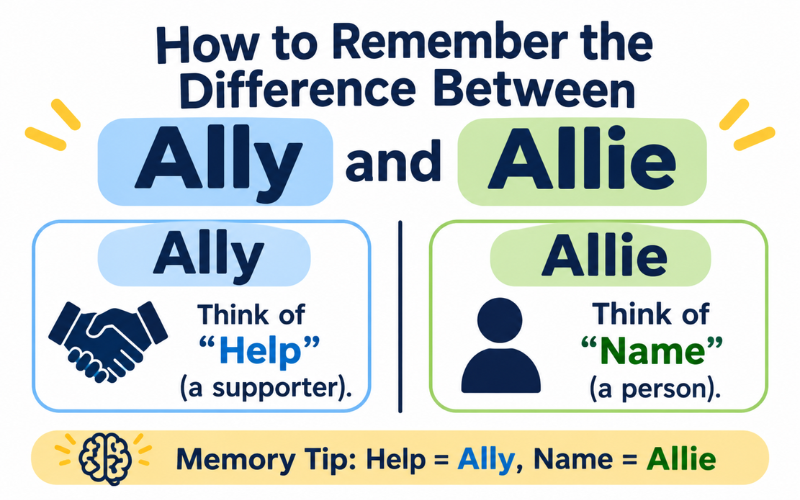
If you often mix up these spellings, a few simple memory techniques can help.
1. Remember the Meaning of Ally
Connect the word ally with the idea of assistance.
For example:
Ally = A person who helps.
Whenever you are describing a supportive friend, partner, or organization, remember to use the spelling ally.
2. Connect Allie With a Person’s Name
Think of Allie as the name you might use when addressing someone.
For example:
“Allie is coming to visit.”
This helps separate the personal-name use from the common English word.
3. Check the Sentence Before Choosing
Ask yourself one simple question:
Am I describing a supporter, or am I writing someone’s name?
- If you are describing a supporter, use ally.
- If you are writing a person’s name, follow their preferred spelling, such as Ally or Allie.
4. Practice With Short Sentences
Try writing these examples:
- My friend is a loyal ally.
- Allie is my childhood friend.
- The two companies became allies.
- I sent a message to Allie.
- She decided to ally with the organization.
Practicing both forms in different contexts can make the distinction easier to remember.
5. Proofread Personal Names Carefully
When writing emails, invitations, school documents, or social media posts, check how the person spells their name.
A spelling checker may recognize both forms, so it might not identify an incorrect personal-name spelling.
The best solution is to verify the name directly.
Ally vs Allie: Practice Test
Now that you understand the meanings and uses of both spellings, try the following questions to check your knowledge.
Read each sentence carefully and select the form that makes the most sense.
Part 1: Choose the Correct Word
1. My best friend has always been a loyal ______.
A. Allie
B. ally
C. alie
2. ______ is coming to our house this evening.
A. Ally
B. Allie
C. Allies
3. The two organizations became close ______.
A. allies
B. Allie
C. allys
4. I invited ______ to my birthday party. Her name is spelled with an “ie.”
A. Ally
B. Allie
C. Allyes
5. Every successful team needs a dependable ______.
A. Allie
B. ally
C. allie
Part 2: Fill in the Blanks
Complete each sentence using the appropriate spelling.
6. My cousin ______ is learning English.
7. A good friend can become your strongest ______.
8. The two countries have remained close ______.
9. I received a beautiful gift from ______.
10. The company needs an experienced business ______.
Part 3: Identify the Correct Usage
11. Which sentence uses ally correctly?
A. Allie is my neighbor.
B. She became an important ally.
C. I invited ally to dinner.
12. Which sentence uses Allie as a personal name?
A. Every person needs an ally.
B. The countries are allies.
C. Allie is studying at university.
13. What is the plural of the common noun ally?
A. Allyes
B. Allies
C. Allie’s
14. Which sentence is correctly capitalized?
A. my friend allie is here.
B. My friend Allie is here.
C. My friend allie Is here.
15. Which spelling should you use for someone whose chosen name is Allie?
A. Ally
B. Allie
C. Allies
Answer Key With Explanations
| Question | Correct Answer | Explanation |
| 1 | B. ally | It describes someone who provides support. |
| 2 | B. Allie | It is used as a person’s name. |
| 3 | A. allies | This is the plural form of ally. |
| 4 | B. Allie | The sentence specifies the person’s preferred spelling. |
| 5 | B. ally | The sentence refers to a supportive partner. |
| 6 | Allie | It identifies the cousin’s name. |
| 7 | ally | It describes a supportive friend. |
| 8 | allies | It refers to multiple partner countries. |
| 9 | Allie | It is used as a personal name. |
| 10 | ally | It describes a business partner. |
| 11 | B | Ally is correctly used as a noun. |
| 12 | C | Allie identifies a particular person. |
| 13 | B | The correct plural spelling is allies. |
| 14 | B | Personal names begin with capital letters. |
| 15 | B | A person’s chosen name should be respected. |
How Well Did You Do?
Use this simple scoring guide to review your answers.
| Score | What It Means |
| 13–15 correct | Excellent! You understand the main distinction. |
| 10–12 correct | Good work! Review the examples for extra practice. |
| 7–9 correct | You understand some differences but need more revision. |
| Below 7 | Revisit the definitions and try the exercise again. |
This exercise is designed for spelling practice rather than measuring overall English proficiency. The main goal is to recognize when each form is appropriate.
FAQs
Is Ally or Allie the Correct Spelling?
Both Ally and Allie are correct spellings when used as personal names. However, ally is the standard English word meaning a supporter, partner, or someone who cooperates with another person or group. Allie is primarily used as a first name or nickname.
Are Ally and Allie Pronounced the Same Way?
Yes. Both spellings are generally pronounced AL-ee in English. The difference is mainly in their written form and usage. Since they sound alike, you may need to ask someone how their name is spelled rather than guessing.
Can Allie Be Used as a Nickname for Allison?
Yes. Allie is commonly used as a nickname for Allison and several other names, including Alison and Alexandra. However, nickname preferences are personal, so not everyone with these names will choose Allie. Some people prefer Ally, Ali, or their complete name.
Conclusion
When comparing Ally vs Allie, the main difference comes down to meaning and usage. Both spellings are acceptable as personal names, but they do not serve the same purpose in standard English vocabulary.
Ally is the correct word when referring to a supporter, partner, or someone who works together with another person or group. It can also be used as a personal name. Allie is primarily a given name or nickname and should be used when that is the spelling a person prefers.
For example, “She is my strongest ally” describes someone who provides support, while “Allie is my best friend” identifies a person by name. Both sentences are correct because each spelling has a different purpose.
If you are choosing a name, either Ally or Allie can be a suitable option. If you are writing about someone else, always respect the spelling they use. Remembering this simple distinction will help you avoid unnecessary spelling confusion and make your English writing clearer.
For More Comparisons Visit: Wordzify
Pingback: Unenroll vs Disenroll: Meaning, Differences, Examples - wordzify.com
Pingback: Dysregulated vs Disregulated: Meaning, Usage and All Info - wordzify.com