
English spelling can be confusing when two words sound almost identical but look slightly different. Dysregulated vs Disregulated is a good example. Both forms may seem reasonable because the prefixes dys- and dis- are used in English to create words related to problems, changes, or negative conditions.
However, when describing a process that is not functioning under its normal control, dysregulated is the standard spelling. It is widely used in medical, scientific, and psychological writing. The form disregulated is generally treated as a misspelling of dysregulated in ordinary English usage.
The word dysregulated can describe emotions that are difficult to manage, a biological process that is not working normally, or a system whose usual regulation has become impaired. It does not simply mean that something has no rules; it suggests that its normal control or balance is not working properly.
Dysregulated
Imbalanced
Disregulated
Incorrect spelling
The Spelling Verdict
Let’s begin with the most important point.
| Word | Status | Explanation |
| Dysregulated | Standard spelling | Describes something whose normal regulation is impaired |
| Disregulated | Generally nonstandard | Commonly treated as a misspelling of dysregulated |
The correct choice for standard writing is dysregulated.
Examples:
- The child became dysregulated after a stressful experience.
- The study examined dysregulated immune activity.
- Researchers observed dysregulated hormone levels.
- She found it difficult to manage her emotions when she felt overwhelmed.
For these meanings, avoid writing disregulated.
What Does Dysregulated Mean?
Dysregulated is an adjective that describes a person, process, or system that is not being regulated in its normal or appropriate way.
It comes from the verb dysregulate, which means to disrupt the normal regulation of a physical or psychological process.
The word is particularly common in psychology, medicine, biology, and scientific research.
Dysregulated in Simple English
A simple way to explain the word is:
Dysregulated = Not properly controlled.
However, its meaning can be more specific depending on the subject.
- Emotions: Feelings or emotional reactions are difficult to manage.
- Body processes: A biological function is not operating within its normal regulatory pattern.
- Behavior: Responses may be unusually intense or difficult to manage.
- Scientific systems: A process is operating outside its normal regulatory balance.
Examples of Dysregulated
- The child appeared dysregulated during the stressful situation.
- Researchers studied dysregulated cell activity.
- The report discussed dysregulated emotional responses.
- Certain diseases may involve dysregulated immune activity.
- The patient experienced changes associated with dysregulated sleep patterns.
The word does not describe one specific condition. Its exact meaning depends on what is being regulated.
What Does Disregulated Mean?
Disregulated is commonly encountered as an incorrect spelling of dysregulated.
Writers may use it because the pronunciation of dys- resembles the sound of dis-. They may also assume that the prefix dis- is more appropriate because it appears in many familiar English words.
However, in standard medical and psychological usage, dysregulated is the established form.
For example:
Incorrect: The research examined disregulated emotional responses.
Correct: The research examined dysregulated emotional responses.
The corrected sentence uses the recognized spelling for a process involving impaired regulation.
It is worth remembering that rare or specialized discussions may use related forms such as disregulation with a deliberately different meaning. That does not make disregulated a standard replacement for dysregulated in ordinary writing.
Related Comparison: Emersion vs Immersion: Meaning, Differences And More
Why Do People Confuse Dysregulated and Disregulated?
The confusion is understandable because the difference is only one letter. Several factors make these spellings easy to mix up.
Similar Pronunciation
Both forms may sound almost identical when spoken. A listener cannot always identify whether the writer intends dys- or dis-.
Familiarity With the Prefix Dis-
English has many common words beginning with dis-, including:
- Disagree
- Dislike
- Disconnect
- Disapprove
- Disappear
Because this prefix is familiar, some writers automatically choose it when spelling an unfamiliar word.
The Meaning Seems Similar
Both prefixes can suggest a negative idea in certain words. This can make disregulated appear logical even though dysregulated is the established spelling for the intended meaning.
Technical Vocabulary
People often encounter dysregulated in medical articles, psychology discussions, research papers, and health-related content. Someone who has not seen the term before may find its spelling unusual.
Dysregulated vs Disregulated: A Detailed Comparison
The following table makes the difference easier to remember.
| Feature | Dysregulated | Disregulated |
| Standard spelling | Yes | No, for the usual intended meaning |
| Prefix | Dys- | Dis- |
| Main idea | Impaired regulation | Usually an incorrect substitute for dysregulated |
| Medical writing | Established | Not the standard form |
| Psychology | Commonly used | Generally avoid |
| Scientific writing | Accepted term | Usually incorrect |
| Recommendation | Use it | Avoid it as a substitute |
The key point is that dysregulated is the form to choose when discussing impaired regulation.
Understanding the Prefix Dys-
The prefix dys- is used in English words to suggest something abnormal, impaired, difficult, or functioning poorly.
It appears in many medical and scientific terms.
| Word | Simple Meaning |
| Dysregulated | Not properly regulated |
| Dysfunctional | Not functioning properly |
| Dyslexia | A learning difference affecting reading and related language skills |
| Dysphagia | Difficulty swallowing |
| Dysrhythmia | An abnormal rhythm |
These examples show why dys- is suitable for a word describing impaired regulation.
In dysregulated, the prefix helps communicate that the normal regulatory process is not working as it should.
Dysregulated in Psychology and Emotional Contexts
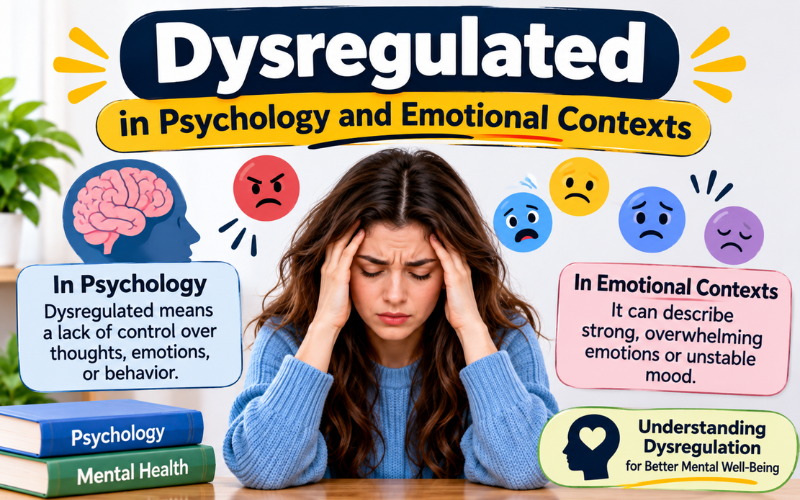
One of the most familiar uses of dysregulated appears in discussions about emotions and behavior.
People do not always respond to situations with the same level of emotional control. A stressful event, frustration, disappointment, or overwhelming environment can make it difficult for someone to manage their reactions.
In psychology-related writing, dysregulated may describe emotional responses that are unusually intense, difficult to manage, or poorly controlled.
Example Sentences
- The child became emotionally dysregulated during the unexpected change.
- The discussion focused on dysregulated emotional responses.
- A stressful environment may contribute to emotional dysregulation.
- The student appeared dysregulated after a difficult school day.
- The therapist discussed strategies for managing emotional reactions.
What Is Emotional Dysregulation?
Emotional dysregulation is a term used for difficulty managing or responding to emotions appropriately.
For example, a person may experience an intense emotional reaction to a situation that others find manageable. The term describes a pattern or difficulty; it should not be used as a diagnosis on its own.
Related Comparison: Tweek vs Tweak: Which Spelling Is Correct?
Dysregulated in Medical and Biological Writing
The word also appears frequently in scientific descriptions of body processes.
The human body depends on many systems that regulate internal activities. These include immune responses, hormone activity, metabolism, and other biological functions.
When a regulatory process does not operate normally, researchers may describe it as dysregulated.
Examples in Scientific Writing
- The researchers investigated dysregulated immune activity.
- The study examined dysregulated glucose metabolism.
- Certain diseases are associated with dysregulated cellular signaling.
- The paper discussed dysregulated gene expression.
- Scientists explored changes in dysregulated hormone activity.
In these examples, the word describes an abnormal regulatory pattern rather than a simple absence of control.
Dysregulated vs Deregulated: Another Difference Worth Knowing
A third spelling can sometimes create additional confusion: deregulated.
Although deregulated and dysregulated look similar, their meanings are different.
| Word | Meaning | Example |
| Dysregulated | Not functioning under normal regulatory control | Dysregulated immune activity |
| Deregulated | Released from certain rules or controls | A deregulated industry |
Consider these sentences:
- The study examined dysregulated biological activity.
- The government deregulated the industry.
The first describes an impaired internal process. The second describes the removal or reduction of official regulation.
Do not use these words interchangeably.
How to Use Dysregulated in Sentences
Here are several sentence patterns that show how the correct word works.
At the Beginning of a Sentence
- Dysregulated emotions can make stressful situations harder to manage.
- Dysregulated activity was observed during the experiment.
- Dysregulated processes may affect normal biological functions.
After a Linking Verb
- The system became dysregulated.
- Her emotional responses appeared dysregulated.
- The biological process remained dysregulated.
Before a Noun
- The study examined dysregulated behavior.
- Researchers investigated dysregulated cells.
- The report described dysregulated hormone activity.
- The paper discussed dysregulated immune responses.
These patterns are useful in academic, professional, and general writing.
Common Mistakes to Avoid
A small spelling error can make technical writing look unreliable. Keep these common mistakes in mind.
Using Dis Instead of Dys
Incorrect: The researchers studied disregulated metabolism.
Correct: The researchers studied dysregulated metabolism.
The established spelling is dysregulated.
Assuming Both Forms Are Equal Alternatives
Incorrect assumption: Dysregulated and disregulated are always interchangeable.
Better approach: Use dysregulated in standard writing when describing impaired regulation.
Confusing Dysregulated With Unregulated
These words are related in meaning but are not always identical.
- Dysregulated: Normal regulation is impaired or functioning abnormally.
- Unregulated: Something is not controlled or restricted by regulation.
Example:
“The biological process became dysregulated.”
“The activity remained unregulated.”
The context determines which word is appropriate.
Using Deregulated in Place of Dysregulated
Incorrect: The patient’s emotions became deregulated.
Better: The patient’s emotional responses became dysregulated.
The words describe different ideas.
Related Comparison: Ally vs Allie: Which One Is Correct?
Adding Unnecessary Hyphens
Incorrect: Dys-regulated
Correct: Dysregulated
Write the word as one word without a hyphen.
Better Words to Use Instead of Dysregulated
Sometimes another word can make a sentence easier to read. The best alternative depends on the context.
| Alternative | Meaning |
| Imbalanced | Not in a balanced state |
| Uncontrolled | Not properly controlled |
| Impaired | Not working normally |
| Disrupted | Interrupted or disturbed |
| Unstable | Not steady or consistent |
| Abnormal | Different from the usual condition |
For example:
- The system became dysregulated.
- The system became imbalanced.
- The process showed impaired regulation.
These alternatives are not perfect replacements in every scientific context. In technical writing, dysregulated may be more precise.
Short Paragraphs Using Dysregulated Correctly
Emotional Responses
The student found it difficult to manage strong emotions after receiving unexpected news. During the discussion, the teacher described the student’s reactions as dysregulated. The word referred to difficulty managing emotional responses in that situation.
Scientific Research
The research team studied a biological process that was not operating normally. Their report described the process as dysregulated. The findings helped explain why normal regulatory activity had changed.
Everyday Behavior
A sudden change in plans made the situation stressful. One person became overwhelmed and struggled to manage their reaction. In this context, the word dysregulated describes an emotional response that was difficult to control.
Medical Writing
The report discussed changes in immune activity. Researchers used the term dysregulated to describe the abnormal pattern observed during the study.
A Simple Memory Trick
If you often mix up these spellings, use this short reminder:
DYS = Dysfunction or abnormal functioning.
Think of the familiar word dysfunction. It also begins with dys- and describes something that is not working properly.
This connection can help you remember:
- Dysregulated
- Dysregulation
- Dysregulate
All three use the same dys- spelling.
Whenever you are describing impaired regulation, remember the DYS prefix.
Practice Quiz: Test Your Spelling
Choose the correct option in each sentence.
Which spelling is standard?
A. Disregulated
B. Dysregulated
Complete the sentence:
“The study examined _____ immune activity.”
A. dysregulated
B. disregulated
Choose the correct sentence:
A. The process became dysregulated.
B. The process became disregulated.
Which word describes a process that is not functioning under normal regulatory control?
A. Dysregulated
B. Deregulated
Complete the sentence:
“She struggled to manage her _____ emotional responses.”
A. dysregulated
B. disregulated
Which prefix appears in the standard spelling?
A. Dis-
B. Dys-
Answers and Explanations
- B. Dysregulated — This is the established spelling.
- A. Dysregulated — It is the standard term for impaired regulation.
- A. The process became dysregulated. — The sentence uses the correct spelling.
- A. Dysregulated — It describes abnormal or impaired regulation.
- A. Dysregulated — This is the correct adjective.
- B. Dys- — The standard word begins with this prefix.
FAQs
Is Dysregulated or Disregulated Correct?
Dysregulated is the standard spelling for something whose normal regulation is impaired. Disregulated is generally considered a misspelling when used with this meaning.
What Does Dysregulated Mean in Simple English?
It means not properly controlled or regulated. The word can describe emotional reactions, biological processes, and other systems that are not functioning normally.
Is Disregulated a Real Word?
It appears occasionally in writing, but it is not the standard spelling used for the usual meaning of impaired regulation. In most cases, use dysregulated instead.
What Is the Difference Between Dysregulated and Unregulated?
Dysregulated describes a process whose normal regulatory function is impaired. Unregulated describes something that is not controlled or restricted by rules or regulation.
Is Dysregulated a Medical Term?
Yes. It is widely used in medical and scientific writing to describe abnormal regulation of biological processes. It is also used in psychology to describe difficulty managing emotional responses.
Conclusion
When comparing Dysregulated vs Disregulated, the standard choice is dysregulated.
It describes a person, process, or system whose normal regulation is impaired. The word is commonly used in psychology, medicine, biology, and scientific writing. The alternative spelling disregulated is generally not accepted as a standard substitute for this meaning.
Remember the connection between dysregulated and dysfunction. Both use the prefix dys-, making it easier to recognize the correct spelling.
For clear and professional writing, choose dysregulated whenever you mean that something is not being regulated properly.
For More Comparisons Visit: Wordzify