
Some English words look so similar that it is easy to mix them up, even when their meanings are quite different. Emersion vs Immersion is one such spelling pair. Both words are correct, but each describes a different action.
Emersion refers to something coming out, emerging, or becoming visible after being hidden. Immersion describes putting something into a liquid or becoming completely involved in an activity, subject, or environment.
Although these words share similar spellings and sounds, they are used in different situations. Immersion is common in everyday English, especially when discussing education, language learning, swimming, and technology. Emersion is less familiar and is often found in scientific or astronomical writing.
Emersion
Coming Out
Immersion
Going In
Quick Comparison: Emersion vs Immersion
Before looking at each word separately, take a look at this simple comparison.
| Word | Meaning | Common Use |
| Emersion | The process of coming out or appearing again | Astronomy and scientific writing |
| Immersion | The act of entering, submerging, or becoming deeply involved | Education, water activities, and experiences |
Quick answer: Both spellings are correct. Use emersion when something emerges or reappears. Use immersion when something is placed beneath a surface or becomes deeply involved in something.
For example:
- The emersion of the moon was observed after the eclipse.
- The students enjoyed their immersion in French culture.
The first sentence describes something becoming visible again. The second describes people becoming involved in a different cultural environment.
What Does Emersion Mean?
Emersion is a noun that describes the process of emerging or coming out from a hidden, covered, or submerged position.
It can refer to an object becoming visible after being concealed. The word is also used in astronomy to describe the reappearance of a celestial body after it has been hidden during an eclipse or occultation.
Emersion is not particularly common in casual conversations. You are more likely to encounter it in scientific reports, technical descriptions, and formal writing.
Understanding Emersion in Simple Words
Think of something that is hidden beneath the surface of water. When it comes back above the surface, it emerges. The process of coming out can be described as emersion.
The same general idea applies when a celestial object becomes visible again after being temporarily hidden.
Examples of Emersion
Here are some sentences showing how this word can be used:
- The emersion of the moon was recorded by the astronomer.
- The diver’s emersion from the water attracted attention.
- Scientists observed the emersion of the celestial body.
- The island’s emersion became noticeable as the water level decreased.
- The report described the gradual emersion of land.
- The observer waited for the satellite’s emersion.
- The camera captured the object’s emersion from the water.
Related Comparison: Nominator vs Nominee, Which Spelling Is Correct?
When Is Emersion the Right Choice?
You can use emersion when writing about:
- Something coming out of water or another covering.
- An object becoming visible after being hidden.
- A celestial body reappearing after an astronomical event.
- The process of emerging from a particular position.
- A movement from a concealed or submerged state into an exposed one.
Main point: Emersion is connected with emerging, coming out, and becoming visible again.
What Does Immersion Mean?
Immersion is a noun that refers to placing something completely into a liquid or becoming deeply involved in an activity, subject, or environment.
It is much more familiar than emersion and appears in many areas of everyday English. You may see it in educational materials, language courses, swimming instructions, travel articles, and discussions about digital entertainment.
For example, a person learning Spanish through daily conversations, reading, listening, and speaking is experiencing language immersion.
The word can describe a physical action as well as a person’s involvement in an experience.
Understanding Immersion in Simple Words
Imagine placing an object completely underwater. That action is immersion.
Now think about someone spending several months learning a foreign language by using it every day. That person is also experiencing immersion, but in an educational environment rather than a liquid.
Examples of Immersion
- The equipment was tested through immersion in water.
- The students enjoyed their immersion in French culture.
- Language immersion can improve communication skills.
- The documentary offered an engaging sense of immersion.
- Her immersion in the project helped her gain experience.
- The swimming lesson included underwater immersion.
- The training program provides immersion in digital marketing.
Where Is Immersion Commonly Used?
Immersion appears in several different contexts:
Language Learning
Language immersion involves learning through regular exposure to a language.
Example: The school offers an English immersion program.
Water Activities
It can describe placing an object or person beneath the surface of a liquid.
Example: The immersion of the equipment was carefully controlled.
Education and Training
A learner may become deeply involved in a subject or practical activity.
Example: The workshop provides complete immersion in graphic design.
Entertainment and Technology
Digital environments can create a strong feeling of involvement.
Example: The game offers an impressive sense of immersion.
The Main Difference Between Emersion and Immersion
The easiest way to distinguish these terms is to look at the direction of the action.
- Emersion: Something comes out or becomes visible.
- Immersion: Something goes in, becomes submerged, or gets deeply involved.
Imagine a swimmer entering a pool and then returning to the surface. Going underwater represents immersion, while coming back out can be described as emersion.
| Feature | Emersion | Immersion |
| Part of speech | Noun | Noun |
| Main idea | Coming out | Going into |
| Direction | Outward | Inward |
| Related verb | Emerge | Immerse |
| Frequency | Less common | More common |
| Typical context | Astronomy and emergence | Education, water, and involvement |
Both words can describe different stages of the same physical activity. Replacing one with the other may change the intended meaning.
Emersion and Immersion in Astronomy
Astronomy is an important field where both words have specific meanings.
Astronomers use these terms to describe different stages of an event in which one celestial object becomes hidden by another object or enters an eclipse shadow.
Immersion in Astronomy
In astronomy, immersion describes the moment when a celestial body enters an eclipse or occultation and becomes hidden.
For example, when a moon disappears behind another celestial object, the event can be described as immersion.
Emersion in Astronomy
Emersion refers to the moment when the celestial body becomes visible again after being hidden.
For instance, when a moon reappears from behind another object, astronomers may describe this event as emersion.
Comparison of Astronomical Terms
| Term | What Happens? |
| Immersion | A celestial body becomes hidden or enters an eclipse shadow. |
| Emersion | The celestial body becomes visible again. |
Astronomy Examples
- The astronomer recorded the immersion of the satellite.
- The telescope captured the emersion of the moon.
- Observers waited for the celestial object’s reappearance.
- The report included the exact time of immersion and emersion.
- The research team compared observations from both stages.
These terms help astronomers describe two separate moments during an observation.
Emersion vs Immersion in Water Activities
Water-related situations provide a straightforward way to understand the difference.
When a person or object goes beneath the water’s surface, immersion takes place. When it returns above the surface, emersion describes the opposite movement.
Examples of Immersion in Water
- The swimmer practiced underwater immersion.
- The equipment was tested through complete immersion.
- The children enjoyed their immersion in the pool.
- The instructor explained the importance of safe water immersion.
- The object remained under the surface during immersion.
Examples of Emersion in Water
- The diver’s emersion was captured on video.
- The swimmer’s emersion marked the end of the underwater exercise.
- Scientists observed the emersion of the object.
- The camera recorded the equipment’s emersion from the water.
A Simple Water Experiment
Imagine placing a metal ball inside a container filled with water.
- First, the ball is lowered beneath the water’s surface. This is immersion.
- Next, the ball stays underwater for a few moments.
- Finally, the ball is lifted above the surface. This movement can be described as emersion.
This simple example shows how both words can describe opposite stages of one activity.
Immersion in Language Learning

One of the most familiar uses of immersion is found in language education.
Language immersion is a learning method in which students regularly listen to, speak, read, and interact in a particular language.
Instead of studying vocabulary and grammar alone, learners experience the language through everyday activities.
For example, someone learning German may attend German-speaking classes, watch German films, read books, and communicate with other speakers.
Examples of Language Immersion
- The university offers a Spanish immersion program.
- Language immersion gives learners more speaking opportunities.
- She joined an intensive English immersion course.
- The school introduced a French immersion classroom.
- Daily immersion helped the students improve their listening skills.
Benefits of Language Immersion
Language immersion can help learners:
- Become familiar with natural conversations.
- Improve listening and speaking abilities.
- Develop confidence when communicating.
- Learn vocabulary through practical situations.
- Recognize common expressions.
- Become more comfortable with sentence structures.
In these examples, immersion is the correct word because the sentences describe learning through regular involvement and exposure.
Immersion in Education and Professional Training
Immersion is not limited to foreign-language courses. It can also describe a learning environment in which students or employees become closely involved with a particular subject.
A professional training program may include workshops, group activities, practical assignments, and real-world projects.
These activities allow participants to gain experience instead of relying only on theoretical information.
Examples
- The workshop offered immersion in digital design.
- Students joined a science immersion program.
- The company arranged an immersion experience for new employees.
- The course encouraged immersion in practical business activities.
- Participants gained valuable experience through professional immersion.
Common Areas of Educational Immersion
- Classroom learning
- Professional development
- Technical training
- Cultural education
- Leadership workshops
- Practical learning programs
Here, immersion refers to deep participation rather than physical submersion.
Immersion in Technology and Entertainment
The word immersion has become increasingly common in discussions about digital experiences.
Virtual reality, video games, interactive films, and computer simulations are often designed to make users feel involved in a digital environment.
For example, a virtual reality headset may display a three-dimensional world that responds to the user’s movements. This can create a strong sense of immersion.
Examples of Digital Immersion
- The virtual reality game offers an immersive experience.
- The film’s sound design creates a strong sense of immersion.
- The simulation allows students to explore realistic situations.
- The interactive environment increases user immersion.
- The digital exhibition provides an engaging experience.
What Is an Immersive Experience?
An immersive experience is an activity or environment that makes a person feel completely involved.
The word immersive is related to immersion, but it is a different grammatical form.
- Immersion is a noun.
- Immersive is an adjective.
Example: The museum created an immersive exhibition for visitors.
Immersion in Culture and Travel
Immersion is also used when someone becomes closely involved with a different culture or way of life.
Travelers may experience cultural immersion by spending time with local communities, trying traditional food, learning customs, and participating in everyday activities.
Instead of simply observing another culture, they become part of the experience.
Examples of Cultural Immersion
- The family enjoyed cultural immersion during their trip.
- Living abroad gave her an opportunity to experience local traditions.
- The exchange program encourages immersion in different cultures.
- Visitors learned about the region through cultural immersion.
- The students participated in local activities during their stay.
Activities That Encourage Cultural Immersion
- Learning local customs.
- Trying traditional meals.
- Attending community celebrations.
- Practicing the local language.
- Understanding everyday lifestyles.
- Taking part in cultural events.
In this context, immersion describes becoming involved in a different social or cultural environment.
Related Comparison: Oversight vs Oversite, Meaning, Spelling, Differences
Pronunciation of Emersion and Immersion
These words have very similar pronunciations, which can make them difficult to distinguish when spoken.
Both are commonly pronounced with an opening sound similar to “ih” and a middle sound resembling “mur.”
| Word | Common IPA Pronunciation |
| Emersion | /ɪˈmɜːrʒən/ |
| Immersion | /ɪˈmɜːrʒən/ |
Pronunciation can vary slightly depending on regional accents and dictionary conventions.
Since their sounds are so close, spelling and context are especially important when writing.
Tips for Practicing Pronunciation
- Listen to each word in a reliable English dictionary.
- Practice saying them in complete sentences.
- Learn their related verbs, emerge and immerse.
- Pay attention to the meaning rather than relying only on sound.
Origins of Emersion and Immersion
Learning where words come from can make their meanings easier to remember.
Origin of Emersion
Emersion comes from Latin emersus, which is connected with emergere, meaning to rise or come out.
Its relationship with the English verb emerge helps explain its meaning.
Related word:
Emerge: To come out or become visible.
Example: The sun began to emerge from behind the clouds.
Origin of Immersion
Immersion comes from Late Latin immersio and is connected with immergere, meaning to dip or plunge into.
This historical meaning reflects the idea of entering or being covered by something.
Related word:
Immerse: To put something into a liquid or become deeply involved.
Example: She decided to immerse herself in learning English.
Word Origin Comparison
| Word | Historical Connection | Basic Idea |
| Emersion | Latin emersus and emergere | Coming out |
| Immersion | Late Latin immersio and immergere | Going into |
Related Words You Should Know
Learning connected vocabulary can help you understand how these terms work in different sentences.
Words Related to Emersion
Emerge: To appear or come out.
Example: The truth began to emerge.
Emergence: The process of becoming visible, known, or noticeable.
Example: The emergence of new technology changed the industry.
Emergent: Developing or becoming noticeable.
Example: The company is responding to emergent challenges.
Reemersion: The act of emerging again.
Words Related to Immersion
Immerse: To place something into a liquid or become deeply involved.
Example: He likes to immerse himself in books.
Immersed: Completely involved or covered by something.
Example: She was immersed in her studies.
Immersive: Creating a feeling of complete involvement.
Example: The exhibition offers an immersive experience.
Submersion: The act of placing something beneath a surface, especially water.
Example: The submersion of the object was carefully observed.
Emersion vs Emergence: Are They Similar?
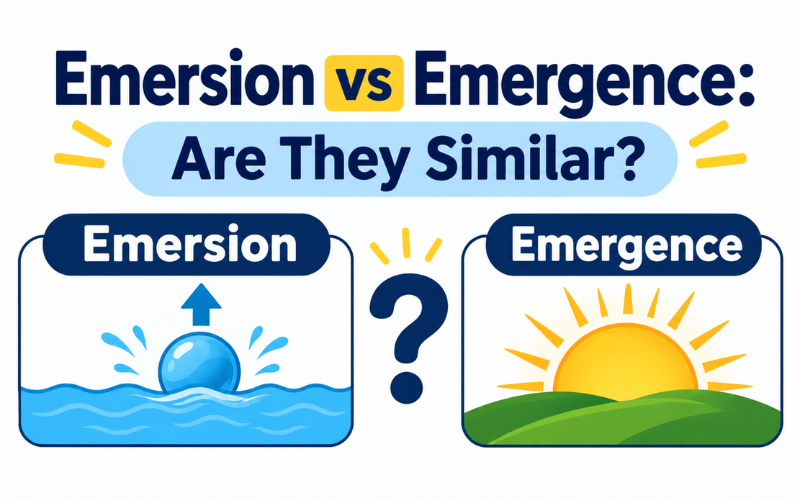
Emersion and emergence are closely related in meaning, but they are not always interchangeable.
Emersion refers to the act of emerging or coming out. It is less common in everyday writing and has a specific use in astronomy.
Emergence is a more familiar noun used to describe the process of appearing, developing, or becoming noticeable.
Compare these examples:
- The emergence of a new business attracted attention.
- The emersion of the celestial body was recorded after the eclipse.
In ordinary writing, emergence is generally the more natural choice when describing something appearing or developing.
Which Word Is More Common: Emersion or Immersion?
Immersion is considerably more common in modern English.
It appears in school materials, language-learning programs, technology articles, travel writing, and everyday discussions.
Emersion is much less familiar. It is generally found in specialized writing, particularly when discussing astronomy or the process of emerging from a hidden position.
| Situation | Appropriate Word |
| Learning a new language | Immersion |
| Going underwater | Immersion |
| Becoming involved in a project | Immersion |
| A celestial body reappearing after an eclipse | Emersion |
| An object coming out of water | Emersion |
| A virtual reality experience | Immersion |
Remember that popularity does not determine correctness. Both words are valid when used in the right context.
Common Mistakes to Avoid
Writers sometimes confuse these terms because their spellings and pronunciations are so similar. However, using the wrong word can change the meaning of a sentence.
Using Emersion for Language Learning
Incorrect: The school offers an English emersion course.
Correct: The school offers an English immersion course.
Why? The sentence describes learning through regular exposure to a language.
Using Immersion for Reappearing After an Eclipse
Incorrect: The astronomer recorded the immersion of the moon after the eclipse.
Correct: The astronomer recorded the emersion of the moon after the eclipse.
Why? The moon is becoming visible again, not disappearing.
Assuming Emersion Is a Spelling Error
Incorrect assumption: Emersion is always wrong, and immersion is the only correct spelling.
Correct explanation: Both words are valid, but they have different meanings.
Choosing a Word Only by Its Sound
The two words can sound almost identical. Pronunciation alone may not help you select the correct spelling.
Instead, identify whether your sentence describes entering or emerging.
Using Emersion for Deep Involvement
Incorrect: His emersion in the research project was impressive.
Correct: His immersion in the research project was impressive.
Why? The sentence describes complete involvement in an activity.
Sentence Structures for Using Emersion
Emersion is a noun, so it commonly appears after articles, possessive words, and descriptive expressions.
The Emersion of Something
Example: The emersion of the satellite was recorded.
Someone’s Emersion
Example: The diver’s emersion took place after several minutes.
After Emersion
Example: The observation continued after the emersion of the celestial body.
During Emersion
Example: The researchers collected information during emersion.
Because this word is uncommon, use it when its specific meaning fits your sentence.
Sentence Structures for Using Immersion
Immersion is also a noun, but it appears in a wider range of everyday situations.
Immersion in Something
Example: Her immersion in English literature improved her vocabulary.
Complete Immersion
Example: The program offers complete immersion in computer science.
Immersion into Something
Example: The immersion of the equipment into the solution was carefully controlled.
A Period of Immersion
Example: A period of immersion helped the students become familiar with the language.
Immersion Experience
Example: The students participated in an international immersion experience.
These sentence patterns are useful in academic, professional, and general writing.
Related Comparison: Tweek vs Tweak: Which Spelling Is Correct?
Emersion and Immersion in Academic Writing
Both words can appear in academic work, but their meanings determine which one belongs in a particular sentence.
Emersion may be suitable for scientific reports, astronomy research, and descriptions of objects becoming visible after being hidden.
Immersion is useful in studies involving education, psychology, environmental science, language learning, and physical experiments.
Academic Examples
- The study examined the immersion of the sample in a liquid.
- Researchers documented the emersion of the celestial object.
- The project investigated language immersion among university students.
- The report discussed the effects of cultural immersion on learning.
- The experiment measured the effects of complete immersion on the material.
A Useful Academic Writing Tip
Do not choose an uncommon word simply because it sounds more formal. Select vocabulary according to its actual meaning.
Clear and accurate writing is more valuable than using complicated words incorrectly.
More Example Sentences Using Emersion
The following sentences demonstrate how emersion can be used in different contexts.
- The emersion of the moon was visible through the telescope.
- Scientists carefully noted the time of emersion.
- The diver’s emersion was followed by a safety check.
- The report explained the process of emersion.
- The object became visible during its emersion.
- The observer waited for the satellite’s emersion.
- The emersion of the land changed the appearance of the coastline.
- The camera captured the emersion of the object.
- The astronomer calculated the expected time of emersion.
- The observation ended shortly after emersion.
More Example Sentences Using Immersion
These examples show how immersion works in everyday and professional English.
- The course provides immersion in English communication.
- The object was tested through immersion in water.
- The students enjoyed their immersion in another culture.
- The program encourages immersion in practical activities.
- The swimmer practiced underwater immersion.
- The museum created an immersive learning environment.
- Her immersion in the book lasted the entire afternoon.
- The training included immersion in real business situations.
- The equipment was designed for underwater immersion.
- Language immersion helped the students practice daily conversations.
Emersion and Immersion in Short Paragraphs

Complete paragraphs make it easier to see how these words work naturally in context.
A Swimming Activity
The instructor asked the students to practice underwater movements in the swimming pool. Their immersion took place under close supervision. After completing the exercise, each student returned to the surface. The instructor then discussed emersion and explained the importance of following safety instructions.
An Astronomy Observation
A group of astronomy students gathered at an observatory to watch a celestial event. They recorded the moment of immersion when the object became hidden. Later, they waited for its emersion. Once it appeared again, they noted the time and compared their observations.
A Language Program
Maria joined a French immersion program to improve her communication skills. She attended classes, watched French films, and spoke with other learners. Her regular involvement gave her more opportunities to practice the language. In this situation, immersion describes her participation in the learning environment.
Practical Tips for Choosing the Correct Word
If you are unsure which spelling belongs in your sentence, use these simple checks.
- Identify the action: Is something going in or coming out?
- Consider the context: Is the sentence about language learning, water, astronomy, or involvement?
- Remember the related verb: Emerge connects with emersion, while immerse connects with immersion.
- Read the complete sentence: The surrounding words often reveal the intended meaning.
- Check the spelling carefully: A spellchecker may not identify a mistake when both words are valid English words.
A Simple Memory Formula
Emersion = Emerge = Come Out
Immersion = Immerse = Go In
Remembering these connections can help you avoid confusing the two terms.
Related Comparison: Ally vs Allie: Which One Is Correct?
FAQs
Is Emersion a Correct English Word?
Yes. Emersion is a valid English noun. It refers to the act of emerging or coming out from something. It is also used in astronomy when a celestial body becomes visible again after being hidden.
Is Immersion the Same as Emersion?
No. Immersion describes going into something, being covered by a liquid, or becoming deeply involved. Emersion refers to coming out or reappearing. Their meanings are different.
Which Word Is More Common in Everyday English?
Immersion is much more common. It frequently appears in discussions about education, language learning, water activities, travel, and technology. Emersion is less common and usually appears in specialized contexts.
Can Emersion and Immersion Be Used in the Same Sentence?
Yes. Both terms can appear together when a sentence describes entering and leaving a liquid or two stages of an astronomical event.
Example: The scientist recorded the immersion and emersion of the satellite.
What Is the Difference Between Immersion and Submersion?
Both words can describe placing something beneath a liquid. However, immersion also has a broader meaning involving deep participation in an activity, subject, or experience.
What Is the Opposite of Immersion?
Emersion can describe the opposite action when referring to something entering and leaving water or another covering. Depending on the context, words such as emergence or surfacing may also express a similar idea.
How Can I Remember Emersion and Immersion Easily?
Connect emersion with emerge, which means to come out. Connect immersion with immerse, which means to put something into a liquid or become deeply involved.
Final Practice Test: Emersion or Immersion?
Choose the correct word for each sentence. Try answering all the questions before checking the answer key.
1. The university introduced a Spanish language ______ program.
a) Emersion
b) Immersion
2. The astronomer waited for the ______ of the moon.
a) Immersion
b) Emersion
3. The diver’s ______ from the water was recorded.
a) Emersion
b) Immersion
4. The students experienced complete ______ in French culture.
a) Emersion
b) Immersion
5. The equipment was placed beneath the surface through ______.
a) Emersion
b) Immersion
6. The satellite’s ______ marked its return to visibility.
a) Immersion
b) Emersion
7. The virtual reality game creates a feeling of ______.
a) Emersion
b) Immersion
8. The swimmer practiced safe water ______.
a) Emersion
b) Immersion
9. The researcher recorded the moment of ______ after the eclipse.
a) Emersion
b) Immersion
10. The training course provides complete ______ in business communication.
a) Emersion
b) Immersion
Answer Key With Explanations
| Question | Correct Answer | Explanation |
| 1 | Immersion | It describes language learning through regular exposure. |
| 2 | Emersion | The moon is becoming visible again. |
| 3 | Emersion | The diver is coming out of the water. |
| 4 | Immersion | The students are deeply involved in another culture. |
| 5 | Immersion | The equipment is being placed beneath the surface. |
| 6 | Emersion | The satellite is returning to visibility. |
| 7 | Immersion | It describes involvement in a digital experience. |
| 8 | Immersion | The swimmer is going beneath the water. |
| 9 | Emersion | The celestial object reappears after being hidden. |
| 10 | Immersion | The course involves deep participation in a subject. |
Check Your Score
- 9–10 correct: Excellent! You can confidently distinguish both words.
- 7–8 correct: Very good. Review the examples where you made mistakes.
- 5–6 correct: You are making progress. Practice the memory formula again.
- Below 5: Revisit the comparison section and try the exercise once more.
Conclusion
The difference between Emersion vs Immersion becomes easier to recognize when you focus on the action described in a sentence. Although both words look and sound similar, they communicate different ideas.
Emersion refers to coming out, emerging, or becoming visible again. It is a less common term that frequently appears in specialized writing, especially astronomy. Immersion describes entering a liquid, being completely covered, or becoming deeply involved in an activity. It is widely used in education, language learning, technology, and everyday communication.
Neither spelling is incorrect. The key is to select the word that matches your intended meaning rather than choosing one based only on appearance or pronunciation.
For More Comparisons Visit: Wordzify
Pingback: Dysregulated vs Disregulated: Meaning, Usage and All Info - wordzify.com